On day four, we were ready to head to Savai'i, the less populous island. Despite the rather discouraging bus-related advice we'd received, we decided to give catching a bus to the ferry terminal a try. We had lost any confidence that we knew what the bus routes were likely to be like, but were encouraged to hear from our hostess that the majority passing in the direction Apia, the main city, would travel through the main hub there, and then we could find a bus to the ferry terminal from there. Which we did, eventually, manage to do. There is no timetable posted anywhere that we could find, and what we had managed to find online before we left was utterly confusing, to the extent that the few things we thought we'd understood about it did not appear to be true in real life. Fortunately, every single person we asked for help did their best to point us in the right direction, and did so as if we'd made their day by asking. So it was hard to be too upset about anything.

Also, Samoan buses are pretty cool. Each one has it's own unique look, but they often have lots of beautiful wood, bright colours and fabrics, and low-tech Plexiglas windows the ingeniously slide in and out of little compartments underneath. Moreover, they are all, without exception, constantly blaring some kind of reggae-island-remix-techno-awesome music. I don't know who makes this music, but it is super positive and energizing and I loved it!
Also, aside from the main Apia hub and the ferry terminal, there are no bus stops, so you just wave a bus down wherever you are, and tap with a coin on the window when you want to get off. Certainly a different system, but it clearly works!
We were going to rent a car at the Savai'i ferry terminal, but the ferry was over two hours late, meaning that we arrived after the rental place closed, and after the last buses had left. (This last information was from the taxi driver who subsequently got to drive us to our fale, and so would be slightly suspect, except again, everyone was so genuinely helpful. Also it did seem unlikely, as we looked around, that a bus was about to show up, so we just went with it.)
Anyway, we arrived at our second beach fale, which was very different from the first, but stunning int its own way. It seems to be a bit in danger of falling into the ocean, but they were working on fixing that while we were there, and we stayed stable. We did have a big storm our first night there, and had to jump up in the middle of the night to pull down all the woven "walls" to keep from getting inundated with a mixture of rain and seawater, but once we'd done that, we were all good.

The mats in this fale were up on wooden frames, which I think is less traditional, but it was convenient.

We had beautiful views of the ocean, including some lovely sunsets!

And glorious sunny days, usually with the occasional cloud cover, which was much appreciated, as any time in direct sunlight was instantly roasting!

I actually can't remember where exactly we were when we spotted this rainbow, but isn't it magical!?

Our first day on Savai'i we rented bikes and cycled to Saleaula Lava Flow. (Side note, I found out afterwards the one of the families at my work is from Saleaula!)
Mount Matāvanu erupted between 1905 and 1911 in one of the biggest eruptions of the 20th century. Lava covered 70 square kilometres of northeastern Savai'i. What you can see of it today is incredible!
Mount Matāvanu erupted between 1905 and 1911 in one of the biggest eruptions of the 20th century. Lava covered 70 square kilometres of northeastern Savai'i. What you can see of it today is incredible!

Lava surrounded the London Missionary Society Church at Saleaula, which remains as a ruin today.


It was amazing to walk through it - it's hard to believe that anything, even these strong stone walls, could have survived that much lava surging through!

And speaking of being impressed - life will find a way, right? These determined plants are thriving, poking up through solid volcanic rock and slowly, slowly turning it into fertile soil.

There was lots of interesting sea life in the nooks and crannies at the end of the lava flow, and most excitingly, we saw a sea turtle!

Further along, there is a lava formation called the Virgin's Grave where, legend has is, the lava parted to go around an innocent virgin. We were a bit confused as to the merits of this, as she must have died anyway if it's her grave, so what did the lava parting accomplish? We didn't attain clarity on this, but it was neat to go down inside the bubble-like formation. Although it was damp and out of the wind and therefore full of bugs, so it wasn't somewhere you'd hang out for a long time.

We found an excellent, peaceful place to have a rest under a tree.
But who, you might ask, is that charming and extremely intelligent person lounging under the tree while Emma does all the photography legwork? Why, it’s none other than myself: Maria, the second adventurer on this trip, and PIC (that’s Partner in Crime) to our lovely blogger Emma since our toddler days. I hope you don’t mind if I cut in here - I promise you’ll get Emma back when I’m done.
Anyway - onward, fellow explorers!
To wrap up our experience at the Lava Fields, we hiked out to a small viewing deck where we saw the aforementioned sea turtle, and admired the ocean against the beautiful lava flows.

On our bike ride back to the fale, we stopped for lunch at a small cafe. We promptly ordered two meals from our server, a young woman named Tia, and then I left to cross the street to a gas station to find a couple of sodas for our lunch. When I returned a short while later, I found Emma seated at a completely different table, gamely forking into a large plate of rice and taro, and chatting away with what I would have mistaken for old friends had I not been pretty sure they were complete strangers. (This was a common theme of our trip.) The “old friends” turned out to be a crew of Samoan electricians on their lunch break, and they quickly recruited us to share their home-cooked meal they’d brought with them, and proceeded to share a friendly conversation on the nature of Samoans and Samoan culture. I was tickled by this display of hospitality, and then slightly dismayed when, after the electricians left, our own (completely forgotten by then) orders arrived! We got through them, though, so don’t worry.
Upon our return to our fale, we discovered several new guests had arrived. Among them were two Australian women with whom we ended up chatting at dinner, and we decided we all quite liked each other! The next morning at breakfast we discovered that they, like us, were planning to rent a car for the day to drive around the island, and we suggested that we all go in on a car together. They agreed, and off we went!
We visited so many beautiful places that day. A lava tube first, much like the others we’d seen on our trip.

On our way to and from the lava tube, we walked through a stunning tropical forest, and were delighted to see a field of pineapples! This is not something you see every day, in New Zealand or Colorado.

Also included in our entry fee for the lava tube was admission to the Footprint of Moso. The story says that Moso was one of the first giants in Samoa, and that his stride was so long you can only find the other footprint by traveling to Fiji!

We also got to see the House of Stone, which was an interesting lava-formed structure that looked like a domed roof.


Emma thought these looked like kawakawa, a native NZ plant. Cousins, perhaps? We also met birds that look just like Emma's favorite NZ bird, the pūkeko, but they can't fly, so how could that be?

Later in the day we visited The Canopy Walk, which was essentially two platforms built way up in the canopy and connected by a plank bridge, but turned out to be so much more fun than that description sounds.

The trees the platforms were built around were fascinating, complex, and massive.

The bridge itself was very prone to swaying and thus slightly unsettling, but lots of fun!

The staircases were quite steep, but there weren’t too many of them.


The view from the top was worth it all!

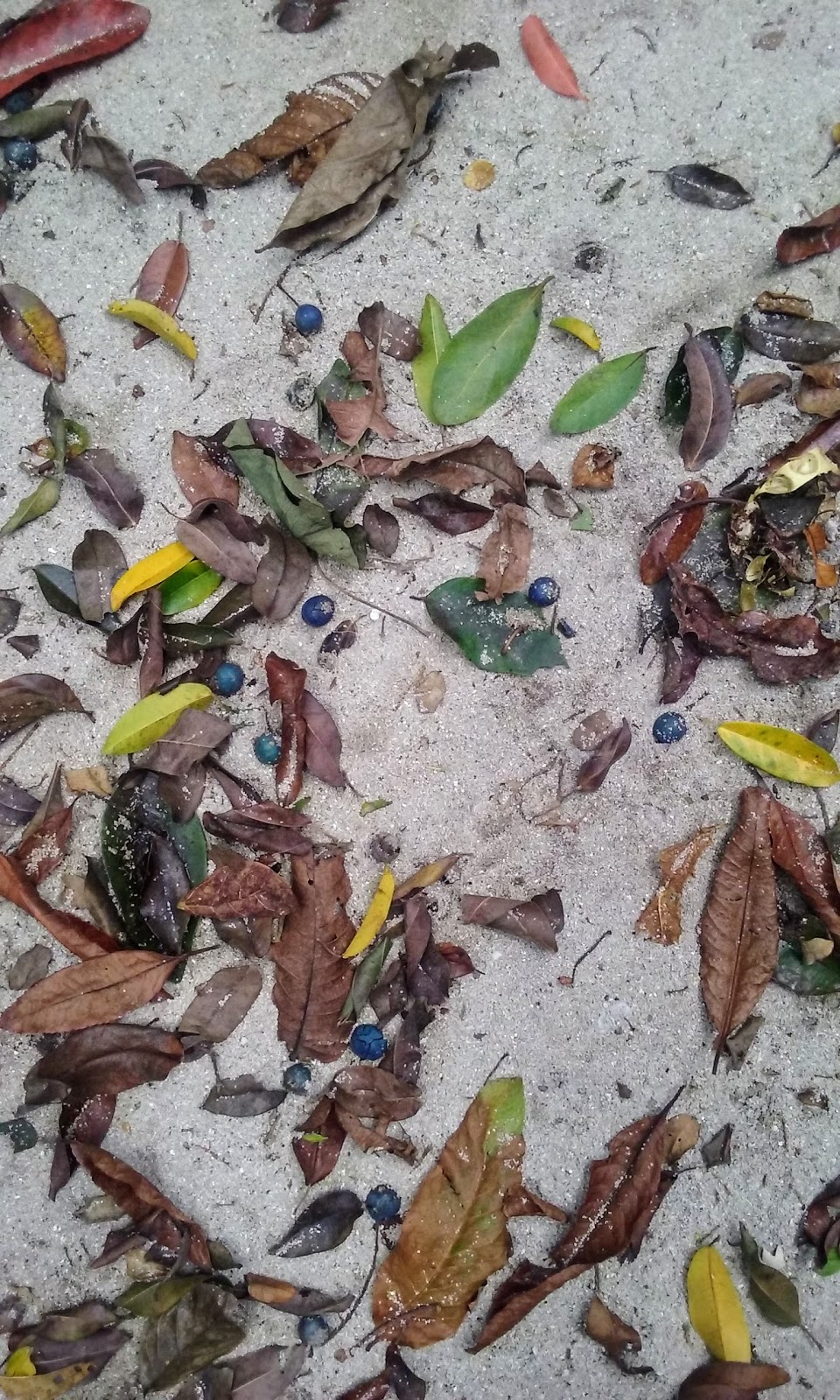
On the way out of the forest we stopped to admire all the beautiful blue seeds (berries?) on the sandy path. I was slightly frustrated (but mostly amused) at my inability to name any plants on either Samoan island, and these little guys especially perplexed me.
Continuing on our drive, we rounded the Western end of the island and stopped at this church near the beach to explore.

At one point, at the Eastern end of Savai'i, we drove through a particularly beautiful forest. That part of the island is the most rural, and it was amazing to visit, although we heard that it feels a bit isolated to stay overnight.

Our second-to-last stop was the Alofaaga Blowholes. The sandy, gently-sloping coast of most of the island had turned into a rather dramatic cliffside while we drove, and as it met up with the fiercer waves of the western Pacific, some pretty neat things were happening!


Timing the photos was the biggest challenge, as the eruptions came on quite suddenly, and when they did you really wanted to be watching instead of photographing, but we managed a few shots.

This is an example of the much more rugged coastline we encountered at this stop.

And yet still covered in lush vegetation!

The colors were my favorite part of this stop, I think.

Our very last stop was an incredibly beautiful waterfall, with lovely, well-maintained paths along the river leading up to it.


Samoa has fascinating hydrology (as described in the first sign photo). The volcanic rock of the island is so porous that any rainfall is immediately absorbed into the ground, and trickles down through the rock to a freshwater reservoir-like formation called a lens. A lens is a body of freshwater that holds its shape against the incoming saltwater of the ocean only by “floating” above the denser mass of seawater. Most of the streams and pools on Samoa were ground-water fed as a result of this supply of freshwater.

Hydrology aside, this pool looked cool, serene, and incredibly inviting to would-be swimmers! Our crew had had a long day, though, and it was time to head home.


