Sunday, September 15, 2019

Thailand Part 4: Homestay

As part of our Intrepid Tour, we had the amazing opportunity to stay at a local Thai family's home overnight. I was really looking forward to this, as I always love to meet real people and get at least a bit of a glimpse of daily life in a new country, rather than just the tourist parts. I was not disappointed - the homestay experience was wonderful!

We stay at Aoi and her family's beautiful house, with this stunning outdoor living room area, complete with hoses attached around the edge of the ceiling to mist water around us to keep us cool. I think it is so amazing to live in a place where your living room doesn't need walls!

We stayed in a lovely upstairs room on mats under mosquito nets. The mats on the wooden floors were a tad firm for me, but I am rather unreasonably bony, so perhaps the fault lies within in this case. Otherwise it was a charming and pleasant space for a good nights' sleep.

The evening we got there, the family taught us to cook "Nam Prik Ong." Sorry for the blurry photo, but at least it's still legible.

This is our happy group learning to use a mortar and pestle. Our Thai teachers cold turn anything into a smooth paste in two seconds flat, but it's not as easy as it looks. Unfortunately, my injured wrist does not allow for such vigorous exercise, but our hosts kindly prepared a paste for me.

Kirsten had an especially wonderful time with her mortar and pestle!

Many of you will know that cooking is not my forte, but I did have a very good time, and between J and our hosts, I was supported in creating a rather delicious dish. (Also, notice the difference in color between J's and mine - that is due to the abundance of chilis in his and the complete lack of them in mine.)

When we were done, we headed inside for an amazing Khantoke dinner. Every bit of it was delicious and cooked to perfection!

Not sure why J looks like a hunchback here, but the rest of us are excited about dinner!

During the meal, we were treated to a beautiful concert. Members of the family participated, and they are all multi-talented, switching gears effortlessly from teaching us to cook to performing on traditional Thai instruments. For a short video clip of the performance, click here.

Afterwards, we got to try out playing the various instruments. The fact that we didn't speak the same language posed no problem at all, as they simply played simple notes or melodies and encouraged us to imitate them.

It was lots of fun! I had to have a try at all of them, of course!

Then we were treated to some wonderful traditional performances by local children, including this boy, who also hung out with us that evening and played Uno. He was delightful! To watch a short clip of his performance, click here.

The girls did several dances. This one was my favourite. Long, thin fingers are considered beautiful, and for this dance they elongate them with golden, tapering wraps. To see a short clip of this performance, click here. To see the younger girls performing a different traditional dance, click here.

As we hung out in the beautiful outdoor living room (can you tell how much I enjoy that whole concept?) we drank lots of delicious Thai iced tea. I don't know much about it, other than it is milky and sweet and served in nearly weightless metal cups, but I love it! Couldn't get enough! And it's a good idea to keep drinking when it's impossibly hot outside, so I had a good excuse to keep going back for refills.

I know I mentioned it before, but we were so fortunate to have such a wonderful group of people to travel with. Just sitting around chatting, playing cards and trying the many puzzle blocks was a delightful way to spend an afternoon.

This next bit is not a "homestay" exactly, but it was a very special moment. Our guide, Nok, took us to her parents' home, where she grew up. Since we'd already gotten to know Nok a little and learn about what a wonderful person she is, it was really meaningful to get a peak into her real life. We met her parents and learned about their interests as well.

Her father has amazing collections of a variety of things, my favourite of which was the little wooden contraption in the upper right, into which you put a dried ear of corn, and then when you spin the handle the kernels get removed. Many of the wooden tools reminded me of my dad, of course. He would have loved seeing them all.

Nok's mom and cousin design, make, and sell jewelry, and a lot of it is made from this very special stone, called Khao Tok Phra Ruang, which is only found in Sukhothai. They gave us this information about it: "Regarded as a sacred item among Sukhothai residents for centuries, large and small black stones called khao tok phra ruang (literally 'popped rice of Phra Ruang'), also referred to as khao phra ruang, occur in the form of a block or cube. A legend has it that this stone came from the sacred words of Phra Ruang, a ruler of the Sukhothai Kingdom around 700 years ago. During his monkhood at Wat Khao Phra Bat, on the day of Tak at Thewo (representing the Buddha's return to earth after a visit to his mother in heaven). Phra Ruang scattered the leftover rice in his bowl and some flowers on the temple ground. He made a wish for the popped rice and flowers to turn into stones that could last for generations. Those keeping this stone with them and paying respect to it are believed to become wealthy and free from all danger. If the uncut square stone is rubbed with lemon juice, the juice will have the quality of counteracting poison from any animal. Because of this ancient belief, the residents of Sukhothai province, especially those from Muang Kao subdistrict, usually bring khao tok phra ruang, available only in the Wat Khao Phra Bat area, for cutting. They also polish it with sand paper until it becomes shiny, resembling onyx. This stone is used for decorating silver-ware, and it is also used in various forms of jewelry, such as necklaces, bracelets, rings, brooches, and earrings. They leftover powder from the cutting process is usually turned into materials for making amulets, which are believed to bring good fortune for the owner."

J bought two bracelets made of khao tok phra ruang, which he is still enjoying, and I bought a beautiful turtle ring (pictured here with some turtle friends we met a few days later). It's lovely to have something that reminds us of our wonderful time with Nok, and that is so uniquely from that one special place in the world.

I still have lots to share about Thailand, but I'm leaving this coming weekend for eight days in Samoa with Maria, so... I'll have figure out how to balance wanting to continue to write about Thailand with what I'm sure will be lots of exciting news from Samoa. What a fabulous problem to have! Anyway, I won't post for a few weeks, but keep an eye out for more exciting things coming soon.

Saturday, August 24, 2019

Zealandia Article

I still have many things to write about Thailand, but I'm taking a slight break from that because I just saw an awesome thing that I'd like to share with you.

I have written several posts about Zealandia over the years, so it will be no surprise to you that it's one of my favourite places. Well, I discovered today that it's not just those of us who live down the road from it who have noticed. It has been named one of Time Magazine's 100 Greatest Places of 2019, and I believe it is truly well deserved. Click here to read the article.

Also, if you'd like to read my past posts about Zealandia, you can click on the following links:
June 2017
July 2016
Aug 2017
Feb 2018

P.S. A Māori restaraunt in Wellington called Hiakai was also on the 100 Greatest Places list, but as I have not yet eaten there, I will save a post about it for when I can weigh in. But it's still wonderful that it's on the list.


Sunday, August 11, 2019

Thailand Part 3: Sukhothai Historical Park

After arriving in Bangkok, we took the bus (a very comfortable one in which you could lay the seats back almost to horizontal) to Sukhothai, a region north of Bangkok. It is the first kingdom of Siam, established around 1250, and the name "Sukhothai" means "dawn of happiness." 

We relaxed and recuperated from the long flights in our beautiful resort the first night, then headed to Sukhothai Historical Park the next day. The park is incredible, and we were very lucky that our wonderful Intrepid group guide, Nok, used to work at this park, so she was extremely well informed. I was torn between trying to jot down notes to share with you all and focusing on enjoying the moment and soaking in all the beauty. I leaned heavily towards the latter, so while I was fascinated with Nok's facts while she was sharing them, I have not retained a huge amount to share here. But I'm hoping that the pictures will be enjoyable and you can forgive me for my lack of expertise on Thai temples, padogas, and ruins. I'll share what I remember.


This is us with Heather and Kirsten, two Americans from our group with whom we became friends. I know I said so in my last post, but just a reminder - we had the coolest tour group, and feel so fortunate!
Anyway, these pillars used to hold up the roof, but now they're all that's left. Also, notice the huge Buddha in the background - not even the biggest one we saw that day!

This is that same Buddha from further away. The whole landscape of the park was strewn with amazing ruins everywhere you looked!

Here's a better shot of that Buddha. My friend Tania had told me about seeing "The Big Buddha" and I was fully convinced that this was it... until we saw the actual one an hour or so later. Don't worry, it's coming.

One of the first things we saw was this amazing four-sided monolith. Nok told us about the writing on it, which is among the first recorded uses of the modern Thai language. She told us that Thai has 44 letters, including 32 vowels, as well as 5 tones. We only learned to say "hello" and "thank you" and probably managed to mess up the tones on both every time we said them. But the language is beautiful to listen to.
 
Nok told us that the standing Buddha is among the most sacred in Thailand.
"Figures of the Buddha walking were first developed by the metalworkers of Sukothai in Thailand in the thirteenth century AD. They stress the active aspect of the Buddha’s ministry and covey his accessibility in the way the Buddha seems to approach the viewer. In his image, the Buddha’s right hand is raised in the gesture of reassurance or the Abhaya mudra." (Quote from buddhastatues.info - please click here to read more of the story.)


This one reminded us of the leaning tower of Pisa. Also, it cast a nice shadow to stand in, which was very important, as it was about 40C (104F).

I kept noticing that the Buddha images were always quite thin and shapely, unlike images we often see in the States. I learned that the fat ones are called "Laughing Buddha" and are much less common in Thailand. 


This set of three shrines was set a little bit apart from the others, and I think it's the most beautiful of all. Nok told us that there are three because one is for Brahma, one for Shiva, and one for Krishna.

Here it is a little bit closer. The area I'm standing in originally had a roof (held up by the pillars you can see in the above picture) and must have been amazing! It still is, of course, but it would have been wonderful to see it the way it was originally designed.

This tree was our favourite of our whole trip, and again, provided some desperately needed shade. Pretty amazing root system, don't you think?

This tree is pretty stunning as well. We think that what look like vines growing around it are actually part of the tree itself.

Alright, we have finally come to the actual "Big Buddha." Can you see how far away I am from that building? And and you see the Buddha's face peeking out of it? That's the best I can do for scale, because it doesn't really fit in pictures. 

 Here he is, in all his glory. Nok told us that the gold on the hand is from people who purchase small pieces of gold leaf and adhere them to Buddha for good luck. It is not allowed, but of course people do it anyway. It is rather pretty, but I wish people would respect the rules.

As an attempt at scale, here is J and I next to Buddha's hand. 

And you can see his face a bit better in this one. He is awe-inspiring!

There are tunnels in the structure around the Big Buddha, some of which lead to stairs you can take up to access to his head. Those parts are obviously off limits to tourists, but J had fun in the accessible parts. 

I think this is a Blue Crested Lizard, and I'm sure that it is very beautiful! And kind, as it let me get rather close.

This park was probably my favourite location in Thailand. It was amazing to see more beautiful structures every time we turned around or cycled around a new corner. If you're ever in Thailand, I highly recommend it! And ask Nok to show you around - she's the best!

Sunday, July 28, 2019

Thailand Part 2: Chang means Elephant

I hope you all enjoyed our guest writer from last month. I was quite sick and stressed for about a week after we got back, and it was very kind of J to write such a lovely post in my stead.

I'm excited to share one of my favourite parts of our trip with you: meeting elephants! Some of my colleagues who had been to Thailand recommended an amazing elephant sanctuary called BMP Elephant Care Project in Chiang Mai, and from her description we decided we absolutely must go.

We had stopped at an elephant hospital a few days before, and learned about the injuries that elephants sustain as a result of elephant riding and logging. Apparently, riding elephants can fracture or dislocate their shoulders and is very bad for them. I had no idea! It used to be a very popular and highly lucrative tourist attraction in Thailand, and is still available in some places, but local and international organizations are alerting people to the dangers to the elephants, and many tourist companies, like ours (Intrepid) refuse to deal with companies that allow elephant riding. 
In addition, elephants were historically used to drag trees down out of the mountains for logging enterprises. That work poses its own issues, but even more tragically, there are now land mines around Thailand's border to prevent crossing it for illegal logging, but people do it anyway, and it's the elephants who suffer, getting their legs blown to bits by stepping on the mines. It's hard to see in the picture, but this elephant at the hospital has a white bag over the stump of her left foreleg. She has a prosthetic that she can wear, but sometimes chooses not to, as she had apparently done that day. This hospital was founded by a local woman and developed the first prosthetic limbs for elephants. they are doing amazing work, but it was all so sad!

We were travelling with a wonderful group of people, and the majority of them also decided to go on a side excursion to BMP, and it was lovely to share the experience with them. One of our newfound friends in the group is particularly fond of elephants, and her excitement was contagious. Being animal lovers in general, and then having the poor elephants from the hospital in our minds, we were all eager to confirm that everything was ethical and that the elephants were treated kindly at BMP. We were trilled to meet happy, well-tended elephants who reminded me forcibly of our wonderful dog Holly who was overjoyed to do anything we asked if it meant she got a treat afterwards. We met four elephants, three of whom were 7 years old or younger. I've forgotten the youngest ones' names, but the 7-year-old was a beautiful girl named Tip, and she and I became good friends. The adult, named, Taeng Thai (which means melon) was also charming. 

First, we made friends with the elephants by feeding some small, sweet bananas. Tip (who I'm feeding here) was so excited she tried to climb over the fence, which you'll notice is up to her shoulders! They were all very eager for the treats, and ate them so fast, peel and all!

Our guide taught us that if you held the banana way up high, the elephants would put up their trunks and open their mouths so you could pop it right in. It was so cool! That's Taeng Thai who the guide is feeding, and then the two youngest next to her.

Next, we each got a load of sugar cane and brought it to the elephants. We learned that elephants only sleep about 3 out of every 24 hours, and pretty much spend the rest of it eating. We also learned (and observed) that they shake out their food before eating it, to get all the insects out of it.

The guide's assistant carried a camera and then shared the photos with us, so we wouldn't have to worry about carrying anything ourselves (except water, as it was about 40C (104F) so we needed to work to stay hydrated). They were obviously used to silly tourists who want a picture of everything (a group to which I somewhat begrudgingly belong, but still manage to feel superior to as a result of having a blog as my excuse). Anyway, they took lovely pictures.

Everything about elephants is fascinating, from their beautiful dark eyes to the different textures of different areas of skin.

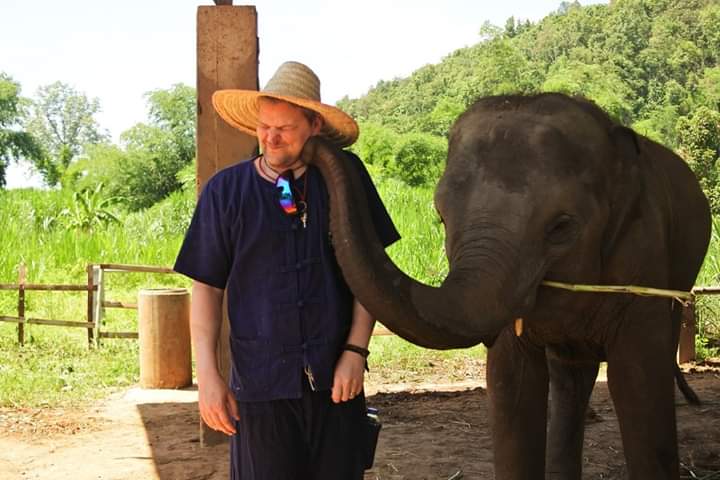
Tip seemed to be the most trained of the group (perhaps because she'd lived there her whole life), and was very good at giving hugs.

She followed each hug with a rather delightful kiss, including causing tickly suction. J's neck is extremely ticklish, but he gave it a try anyway, with satisfyingly hilarious results.

This is my favourite picture from our whole trip! How completely adorable is that? Tip is so photogenic!

After the elephants finished their sugar cane, they went down for a swim in the river, where they ate something that looked to me like water lilies. They also helped us to cool down. We could see their handlers (who live with them at the sanctuary and have strong, lifelong partnerships with them) giving them signals and talking to them, but didn't realize what they were saying until the sheets of water spurted out of their trunks!

Then came my favourite part. We followed the elephants into a squelchy, muddy pond (that reminded me of my Uncle David and Aunt Susan's mud pond, the location of some pretty fantastic childhood memories). It was such a relief to wade into the cold water after ages in the sun, and it was clear that the elephants enjoyed it too. We gave them a mud bath, scrubbing and spreading the cool mud all over their amazing skin.

You'll notice that most of the rest of the group got in the water up to around the knee area - not me! I'm the little one behind the lounging elephant. In their defense, I should report that there was definitely elephant poop floating in the water, in addition to whatever delightfulness lurked in the mud, but even J the germ-a-phobe knows that herbivores' poop is very nonthreatening germ-wise, and plus, we were swimming with elephants! I wasn't going to go half-way on that! Also, it probably helps that I grew up swimming in mud ponds. Thanks, David and Susan.

Then we went into a clean(ish) pool and rinsed all the mud off. I definitely managed to get as muddy as the elephants, which I always consider a win when it comes to mud ponds.

After the clean pond, we changed back into our regular clothes and had a delicious lunch together by the river, then headed back into town. It was actually hard to believe that so many amazing things had happened in just one morning. We were exhausted from the heat (which will be a common trend in my posts) but also I think worn out from so much excitement! J and I took a long nap when we got back to the hotel, and I don't think we were the only ones.

I will now share some other elephant-related photos from our trip, starting with this rather clever towel elephant in our first hotel. Elephants are very important in Thailand, and so they are represented in a lot of art, temples, and other cultural landmarks. (And, apparently, hotel towels.)

I will write a post about our day in Sukhothai Historical Park, but I decided that this elephant pagoda belongs in this post. That's J on his bike, riding by.

It's hard to see the beautiful detail in that first picture, so here is a close-up. I love how they are stepping right out of the bricks!

This white elephant is at Wat Phra That Doi Suthep temple. White elephants are very rare and sacred. Traditionally, when a white elephant was born, it would be considered the property of the king, and transported to the palace. The town where it was born would receive honour and good luck. 

At the same temple, I found this image of Buddha on an elephant. I feel like Buddha could probably manage to make sure not to hurt the elephant while riding him.

We also saw this incredible carving at that temple, which is in Chiang Mai and will get its own post later.

This is a close-up of one tiny part of it, in which sacred elephant are carrying sacred relics up to this very temple (if I'm remembering right).

So there you have it. Elephants are amazing, and Thailand values them very highly and is putting great effort into showing their respect for them. I can't describe how fortunate I feel to have met those incredible four elephants at BMP, and to have shared a morning with them, J, and our wonderful new friends in our group.