Sunday, August 19, 2018

Taranaki Falls Walk, Tongariro National Park

As many of you know, J and I enjoy snowboarding as often as we can in the winter. We have to make hotel reservations several weeks in advance, as every accommodation anywhere near the mountain fills up. This means that we can't pick weekends based on weather, and we just enjoy snowboarding in whatever conditions we end up with. Unfortunately, it is often rainy or windy, and last time we went it was pouring rain, which we were okay with until my waterproof coat failed, and I got soaked. Oh well. This time, as we drove up the mountain, we were delighted to see that it was sunny, not windy, and just all-around stunning. Wow, finally some good luck!

See? This is on the way, and you just couldn't imagine a more snowboarding-ready mountain.

Well... perhaps our good luck was too good to be true. Apparently, lots of people do choose to come to the mountain at the last minute based on the weather, and all of them and all their friends noticed that it was the perfect weekend. As we got closer to the ski field, we saw a big sign saying that the carparks were full, so you'd have to take the shuttle. No problem. We got in line for the shuttle, and then were told that no more shuttles would be taking people up, as the mountain was too crowded. So... no snowboarding for us. Unbelievable. We learned later that this often happens on the first nice weekend of the snowboarding season, but after that even sunny days are more reasonable, so that's encouraging.

In any case, we decided to take advantage of the beautiful day in a different way, and did the Taranaki Falls Walk. I'd done part of it with Aunt Susan when she was there, but such amazing experiences don't get old, and it was a fantastic time. J is not as enthusiastic about stunning scenery and lovely hikes as I am, but he did have a delightful time teaching me about the lichen we saw as we walked. Who knew lichen was so fascinating? (Well, J did, obviously, but now I do too). 

This is at the beginning of the walk.

I'm not sure why exactly, but I find this picture intensely striking. That's Mount Ngaurahoe with the snow on it, and Mount Tongariro next to it.

This will be a repeated feature of these pictures: Check out the amazing colours in the grasses!

I love walking next to a stream, as the sounds are so peaceful and invigorating at the same time. (Incidentally, I just learned that the smell of oranges is like that too).

At first, I thought this was Taranaki Falls. I was quite pleased with it, as it is a huge, beautiful waterfall, but there were bigger things to come.

The grasses aren't the only things with fabulous colours. The rocks contribute as well. 

Even on a tiny scale, there are just so many fascinating colours, shapes, and patterns.

This is Taranaki Falls, for real.

And up closer.

Looking back along the river at the bottom of the falls.

This is looking towards Mount Ruapehu (where we would have been snowboarding) but you can't see it as well as the others.

I've made this picture extra big, because what I love about this view are the many layers of hills as you approach the horizon. Unfortunately, they're quite hard to see in the picture.

This is my favourite picture to illustrate the colours I keep going on about.

This is getting towards the end of the walk, which is a loop. It only takes about 2 hours, and doesn't have too many steep climbs, which is good. I still have a sore knee, and 2 hours is about 1 hour and 45 minutes longer than I've been walking lately, as I'm trying to help it heal. However, I've been encouraged to try some walking in my new orthopedic shoes, and I'm pleased to report that the pain in my knee, which is constant, stayed stable during the whole walk, which is very impressive and a major improvement over the intense pain I have been getting after just a few minute walking.

We did get to snowboard the next day (after getting up very early and still getting stuck in bumper-to-bumper traffic on the way up), and it was glorious. I'll post some pictures soon. On a related note, since we're spending a lot of weekends out of town, and since I'm finding it hard to make time to write blog posts (as evidenced by the lack of one last weekend), I think I'll shoot for posting every second weekend for a while. I still enjoy posting, but I am short on "free" time, and I am trying not to overcommit myself any more than I already have.

Monday, August 6, 2018

Our Prime Minister

This post is going to be short, sweet, and not actually written by me. I almost never share "viral" pictures or articles, but this one came to my attention on Facebook, and it made me really proud, and I wanted to pass it on. I am so honoured to live in this country for so many reasons, and this is now definitely one of them. I highly recommend that you Google Jacinda, because she's doing lots of great things.

"This is The Prime Minister Of New Zealand, Jacinda Ardern. She's 37. She's the youngest female Head of Government in the world. She's also the first western woman to give birth while in this position of power. 2 days after the baby was born - with midwives, standard in NZ hospitals - she introduced her to the country during a press conference on the nightly news. It was really lovely. She named her Neve Te Aroha. Te Aroha means "The Love" in Māori. It represents ALL the names that were submitted (upon her request) from various tribes throughout the country, and was her attempt at capturing them all.
This is her and her partner, no, he's NOT her husband (gasp!), walking to the press conference. He's TV fishing show Host Clarke Gayford, and HE will be staying at home with baby Neve when his lady goes back to running the country in 6 weeks. Clarke sports a snazzy sweater he picked up at the op-shop (second-hand store) in Gisborne, and thinks its just kinda logical and he gives up his day job to stay home and look after the baby.
A week after the birth on July 1st Jacinda introduced a $5billion Families Package that she'd drafted on the floor of her friends house in Hastings - long before her pregnancy. It's based on the knowledge that the first few years of a babies life are the most important. The package gives an extra $60 a week to families with new babies, and an extra $700 to families for winter heating costs as well (it's cold as hell down there in the winter). It also increases the Paid Leave for new parents from 18 weeks to 22 weeks. She announced the details via Facebook live, from her couch, right after she'd finished breastfeeding the baby. Because Kiwis. Some of the most down-to-earth, no-drama-having, just-do-it kind of people you'll ever meet.
And because Women. We really do know how to lead, and to do it well."

Sunday, July 29, 2018

Rarotonga Part 6: Cultural Experiences

Whenever we go to a new place, we like to learn about the local culture, and do our absolute best to be conscientious tourists. We weren't always sure of the best ways to do that in Rarotonga, because it felt like there were more tourists than locals on the island, and everything seemed so dependent on tourism. But we did our best, and we did learn a lot about the local culture, which was wonderful. It would be ridiculous to try to share it all with you, but I've selected some highlights.

On our Jungle Quad Adventure, our guide told us about this tree, called an Au Tree. It is used for many medicinal purposes, and our guide showed us how you can mash up its leaves in your hand and after just a minute, you can squeeze out liquid, which is very helpful if put on cuts or sores. 

This is our guide, who also told us about this ruin. Apparently, a missionary came here and started constructing a church. The local leaders were supportive of this, until they found out that they were also building a crematorium behind the church. It is a very important part of their belief system that people return to the earth after they die, and so cremation is inappropriate to say the least. The church was therefore never completed on this site, although the missionary did find another location where the local leaders allowed his church and crematorium. It's sad, but unsurprising, to hear that even after realizing that his practices were inconsistent with local beliefs, he still continued his plans.

On our first stop on the Progressive Dinner we went on, our host took us around to his backyard, and showed us lots of interesting things, including this above-ground umu. An umu is an earth oven, where traditionally they would dig down, make a fire, put volcanic rocks on top, and once they were hot, cook their food wrapped in banana leaves. The banana leaves turn from green to brown during the cooking process, and keep the food nice and moist. Our host told us that they discovered that they could do the same thing with a heavy metal bowl inside this chemical container, and they're enjoying using that as well as the two underground ones they have. It reminded me of living with the Lubicon Cree tribe in Northern Canada, where we often saw traditional practices mixed with a "make use of whatever comes your way" attitude, resulting in very similar mashups.

Our host then showed us a way that coconuts are used. You take a coconut that has sprouted a new tree, bury it on the beach, and then cut the sapling off. The tree knows it will need to regrow, and so it puts more energy into creating food for the sapling, which is the flesh inside the coconut itself. If you do this over and over, the coconut gets more and more full and delicious, ending up, after multiple cuttings, like candy.

He said that they wouldn't usually break one open before cutting it several times, but he wanted to show us the process. It's hard to see in the picture, but there is a metal stake sticking up from the ground, which he used to break open the outer shell.


Underneath are hairy fibres called husks, which he pulled away. A coconut you would buy in the store has the outer shell and the husks removed, but he said once you get rid of those, it can't grow, so you'd always plant them whole. He seemed a bit sad to have used this one up in the demonstration, depriving it of its potential to grow.
(I apologize for the blurry picture, but it was getting dark. Also, on a side note, there were lots of chickens around, and they seemed to be competing for the best places in the trees to roost for the night, because they were being rather boisterous, making it hard to hear him.)

When the broke open the inner shell, it looked like this. We got to taste the foamy stuff in the middle, which was interesting and mild in both texture and taste. Apparently, as you cut off the sapling more times, that inner part gets harder and sweeter, more like candy.

This was our host at the second location for the Progressive dinner. All three of our hosts talked about the importance of owning land on Rarotonga, and how difficult it is. Our first two hosts had married someone who owned the land they now lived on, and the third's family had been there for generations. Only natives of Rarotonga are allows to own land, so even Cook Islanders from the other 14 islands can't buy land there. This was on our last night, and it made me think of a nice lady we met who had been living on Rarotonga for 30 years, but was originally from Australia. She must either be renting or have married into a native family.

Our resort has a weekly "Island Night" where you can sample traditional Rarotongan food (see my last post) and learn about traditional dances. This man was the host of the evening, and as he walked by our table, he stopped and asked if we wanted a picture, which of course we did. His traditional clothes were amazing.

The dances and music were beautiful, although we were disappointed to see a "Discover Paradise" advertisement for our resort centre stage behind the performers. Commercialism detracts greatly from the celebration of a culture, and that was not the only thing about the evening that felt much less authentic than we would have liked. We tried to focus on the music and dancing and not worry about the rest. If we ever go again, we will find a tradition performance in a more authentic setting if we can. (We should have known this already, but I guess we just didn't think it through.)

The women dancers did lots of hip and arm movements, and the men did more with their legs and especially their knees. The traditional dance outfits were beautiful, especially the women's headdresses. Many parts are made from various parts of the coconut and coconut tree, as well as from flax (as is also true in NZ).

 
You can see a bit in the background on the right of the wooden pa'u, which are traditional drums. Drums are the central sound in all the music we heard, with ukuleles joining in with the melody. In almost every song, the beat started out reasonable slowly, and there was often singing along with the ukulele melody. Then, about 2/3 through, the beat would suddenly become very fast and the drums would be proportionately much louder. The dancers' movements would become much faster and more staccato. This would continue for the rest of the song. It was fascinating to watch the change, and both styles were beautiful. 

If you click on it to make it bigger, you should be able to read these plaques, which we noticed at the Punanga Nui Market, and which celebrate the ongoing positive relations between Rarotonga and NZ.

This is Tuoro: Nga'i Reranga Varua (Departure Point of Spirits). It is locally known as Black Rocks. According to the plaque up by the road, "It marks the boundary between the districts of Te-Au-o-Tonga and Puaikura. The abundant black rock in the area, from which it derives its English name, is basalt. It is estimated to be 1.9 million years old. 
"Tuoro" means to proclaim, or to challenge by calling out loudly to, as a sentry who challenges anyone approaching. Tuoro is believe to be the place where spirits of the dead leave Rarotonga. Those spirits ascend a pua tree and leap from it to commence their journey back to their ancient homeland, Avaiki, to the west. Similarly, the Māori people of Aotearoa (NZ) believe that Cape Reinga, in the North Island, is the departure point for the spirits of the Māori people to Hawaiki."

Tuoro is a very beautiful place, and it was lovely to explore. We went past it at dusk (when the first picture was taken), and then I went back the next day to explore further. When I got there, a person was flying a kite shaped like a bird from the top, and I found that very poetic, because it was like spirits taking off for Avaiki. In several of the beautiful Māori pūrākau (legends) I read with my children, the spirits of characters take the form of birds. I don't know if the person flying the kite saw the symbolism or not, but it was a lovely moment for me.

This concludes my posts about Rarotonga. It was an amazing trip, and we both really enjoyed our time there. I don't know if we will go back, as there are so many other new places to explore, but it is certainly a very special place.

Sunday, July 22, 2018

Rarotonga Part 5: Kai (Food)

While we were in Rarotonga, we ate a great deal of impressive food, and I feel that an account of our trip would be incomplete without some acknowledgement of all the deliciousness.

Of course, we had lots of fabulous drinks on fabulous beaches. J's almost always included alcohol, and mine never did, and both were good. Notice the lovely starfruit on this one! I also got to taste delicious star fruit on our quad adventure, when the guide picked one straight off the tree and gave it to me. Just the right way to enjoy them.

At that same restaurant, I had battered yellow fin tuna, caught right there, of course. Little did I know it then, but I was going to eat yellow fin tuna prepared an astonishing number of different ways during our time there.

This is that restaurant from the beach.


We went to Island Night, which I will write more about in my next (and last Rarotonga) post, but look at all this food! We misunderstood what time dinner was, and ended up waiting around for an hour, enjoying the peaceful evening but getting very hungry, which turned out to be a good thing, as we both ate so much food!

Here was my first plate of food. Notice the brown and white stuff at the bottom. It doesn't look very appetizing, but it's actually a local delicacy called poke (pronounced poke-ay), made from bananas. You boil them, mix them with arrowroot starch, and bake them, and they end up jelly-like, and then they're served with thick coconut cream. We both thought it was divine.
Next to it, by the chicken leg, is a food I've forgotten the name of, but it's also a local specialty, and it's made from the top green parts of taro plants, which are like spinach, and it was also delicious.

Multiple people recommended Le Bon Vivant, or LBV, as the best restaurant on the island. We biked quite a long way (in island distance) to get there, and we were not disappointed. J had a burrito and I had chicken tacos, and they were both out of this world. Also, a shy but eager waitress came over to ask J if he was a movie star, as apparently all the waiters and waitresses were in the back Googling him, as they thought he was the actor who played Superman in the new movie! So funny! 

We also enjoyed Vili's, which some say has the best burgers on the island. We liked our burgers, and also enjoyed the chickens hanging around hoping that they could steal some fries.

We both enjoyed drinking coconut nu, which is the milk from the young coconut. We learned that in the "olden days" (as my children like to call any time more than 5 years ago), if mothers had trouble breastfeeding, they would feed the newborns nu, and even that once when they ran out of liquid for the IVs in the hospital, they used nu! (J was not a fan of either of these practices, but agreed that in times of scarcity, it's probably not the worst option.)

One of the places where we drank nu was at The Lazy Trout, which had this delightful guy relaxing out front.

J claims that this carrot cake was the most delectable thing he's ever tasted, although I should mention that he was reasonably generous with such praise during our time there. The beautiful drink next to him was quite tasty as well.

This is ika mata, which means raw fish (in NZ Māori as well as Cook Island Māori). It is prepared with coconut milk (a major staple), lemon, cucumber, onion, and often other veges. I had it quite a few times while we were there, as it was amazing. Often, it was made with yellow fin tuna.

I also had yellow fin tuna at a fancy restaurant we accidentally found, where they'd cured it with beetroot, which was probably my favourite way to eat it, actually. Plus, look how gorgeous and red it made it! (This whole salad was incredible.) I also had grilled yellow fin tuna, and I think there was another style, but I can't remember.

I debated putting these next pictures in my last post, which will be about culture, but I decided to put them here and save some others for that one. These pictures our from the Progressive Dinner we went to on our last night there, during which we were welcomed to the homes of three local families who served us food and taught us about their lives in Rarotonga.

This was the first place, where we had appetizers.

There was taro and manioc to try - both root vegetables a bit like potatoes, but starchier. The whitish stuff in the bigger bowls to the side is homemade ika mata (raw fish), and it was better than any I'd had at restaurants. And then the orange stuff is pawpaw... salad, maybe? Not sure what you'd call it, but it was mind-blowingly good. I didn't even know that I liked pawpaws, but now they're a favourite!

This is the next house we went to, and we ate on the terrace by that beautiful balcony. It was fabulous. Sadly, I didn't take any pictures of the food here, but I remember that we had amazing poke (the banana dish) and "Island chips" which are fries made out of taro and manioc, which I just could not get enough of. They also had amazing fruit smoothies.

Apparently I only remembered to take a picture of my plate of food at the last house, which is unfortunately not very exciting looking, but the food was amazing, especially the bread-coloured stuff on the left, which was an incredible banana dish. Rarotongan cooks can do an impressive number of things with bananas and coconuts.

In conclusion, if you go to Rarotonga, I recommend trying all the food on offer, because it was all impressive.

Monday, July 16, 2018

Rarotonga Part 4: Beautiful Beachiness

I realize that I already put lots of beautiful beach photos in my first Rarotonga post, but despite my herculean efforts to keep my photos to a manageable number, there are still lots more that I couldn't bear to delete.
See? Look at that? How do you delete that?

Anyway, the pictures are wonderful and I hope you enjoy them. I won't be saying a lot about each one, partially because they don't need a lot of explanation, and partially because I'm on day two of a debilitating headache and words are hard right now. Anyway, don't worry about my rambling, and just enjoy the beauty.
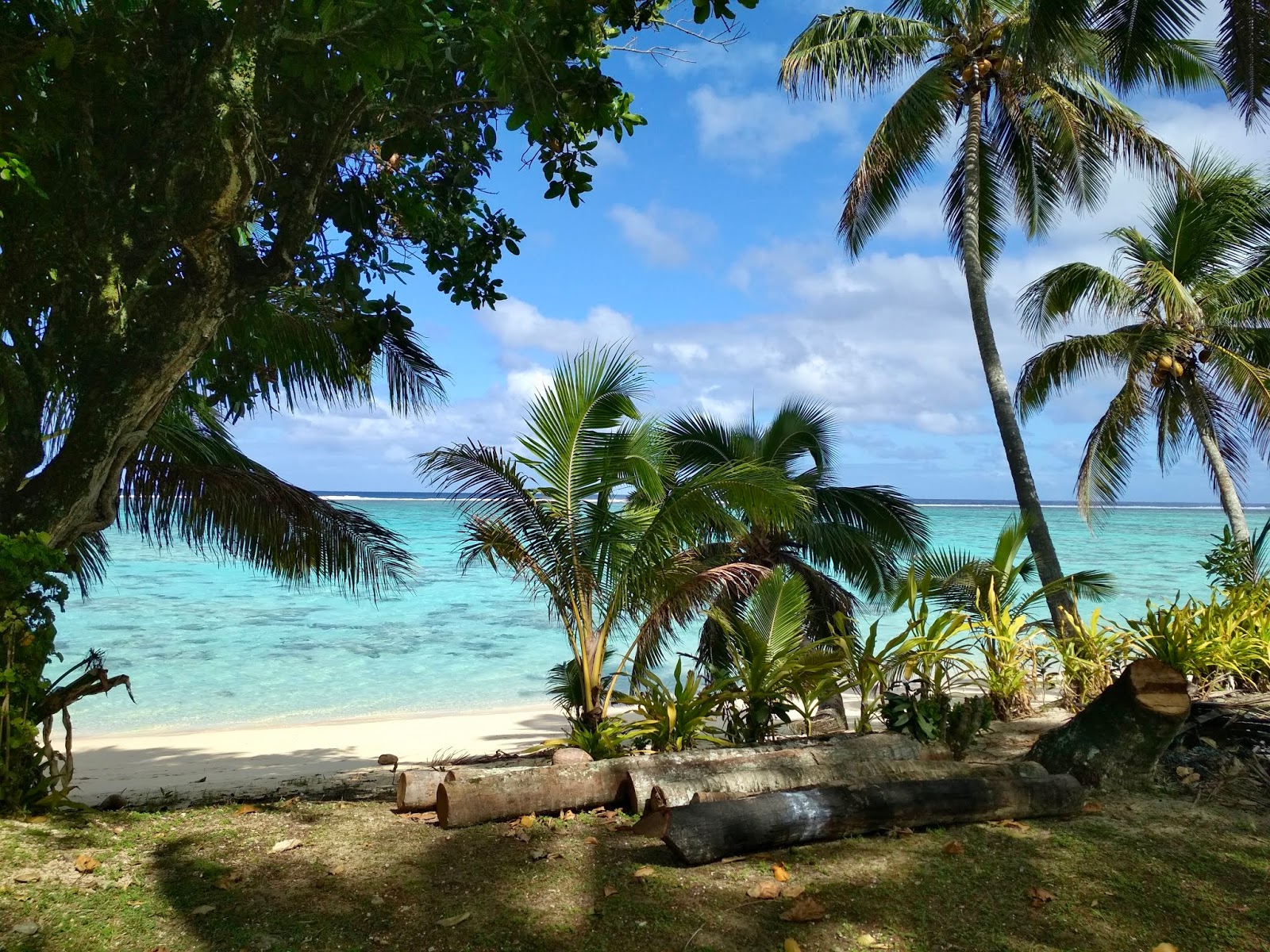
J's favourite way to swim is by floating on his back, and his ideal time is dusk.

As I mentioned, the beach is covered in diverse and fascinating coral formations, due to the close proximity of living reef to shore.

Sometimes the coral is imbedded in the rocks, which is fun.

I was walking along this stretch of beach when my audio book described a tropical paradise which exactly matched what I was looking at. Fabulous moment in the life of a book-lover.

I can't get over the colours of the water.

During the time each day when J and I did our own thing, I was usually on the beach, listening to an audio book (a fantastic series about dragons, to be exact), with one earbud out so I could also enjoy the ocean sounds.


I am still having trouble with my knee, and can only walk for short periods of time, so I took frequent breaks and just watched the water (which is why I had an audio book instead of a vision-dependent paper book) or drew in the sand.

When I exhausted the short list of things I can draw, I switched to rock/coral arrangements. 

This one was not artistic, but it was fun and beautiful. I am still amazed at all the different tiny things I could find when I started looking.

Several days in, I noticed the ridges in the sand from the waves, and then really enjoyed walking in the troughs in between.

J's preference for dusk dovetails nicely with my enjoyment of sunsets, especially over water, so we watched the sun go down almost every night.

One day, J was so hot after our bike ride back to the hotel, that he walked straight into the water, fully dressed.

I don't know what it was about the lighting or the angle, but somehow you can see the coral under the water in this picture, which I didn't expect and is fabulous.

It's hard to tell in the picture, but those vines on the ground to the left are covered in beautiful pink flowers.

I'll write more about this rock in a later post, but it's included here just for its beauty in the multicoloured water.

Another lovely sunset.

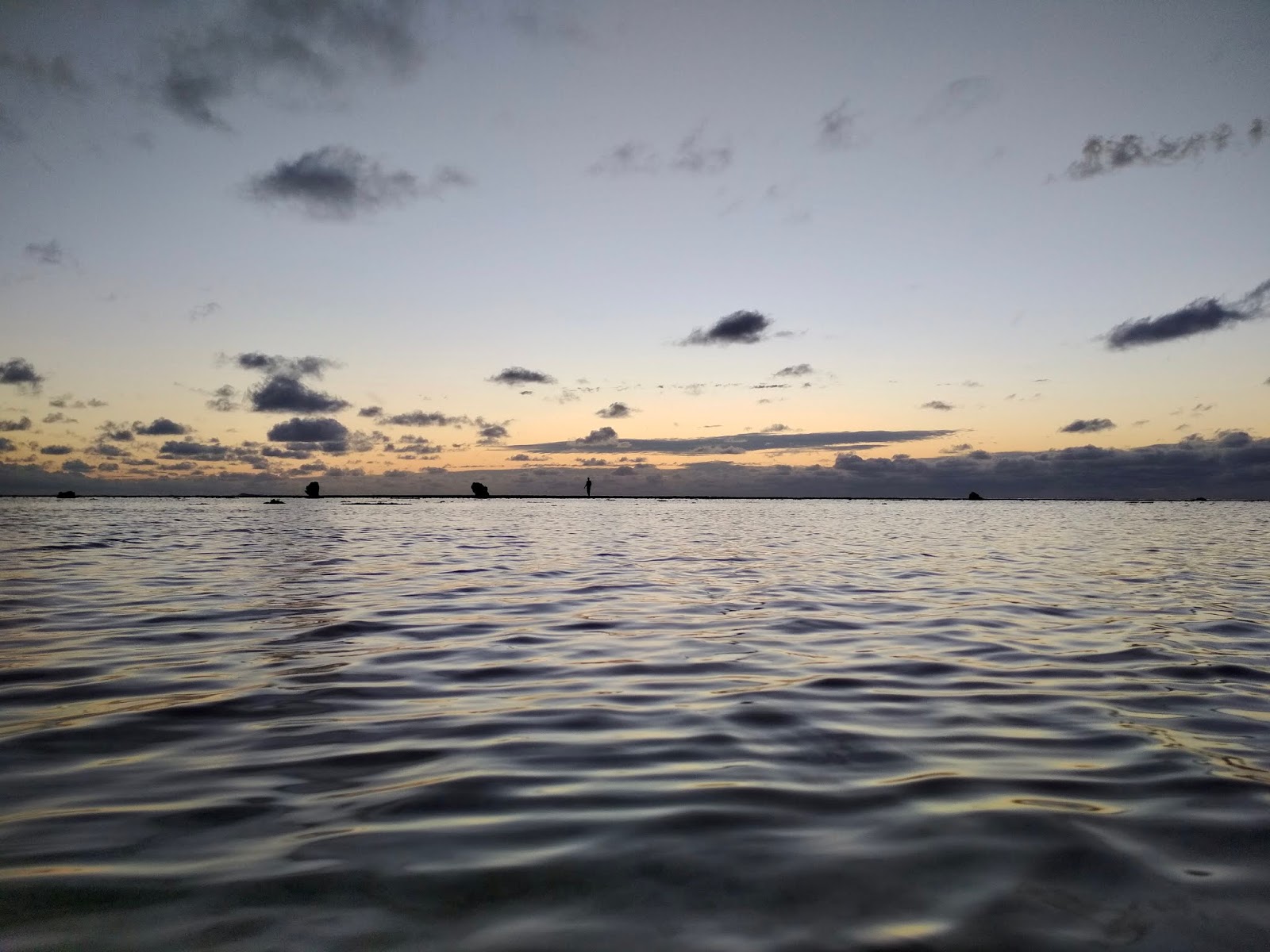
See the tall, thin dot of black towards the middle at the horizon? That's J out walking on the barrier reef at the edge of the lagoon.

This might be my favourite view from our whole trip.

There were many very awesome tide pools. This actually looks like the one we saw the lionfish in, although it is not.

This is from the shore where we went paddle boarding.

I'm going to go rest my head. I hope I am feeling more expressive next week, as I'd like to write about our cultural experiences.