Sunday, August 11, 2019

Thailand Part 3: Sukhothai Historical Park

After arriving in Bangkok, we took the bus (a very comfortable one in which you could lay the seats back almost to horizontal) to Sukhothai, a region north of Bangkok. It is the first kingdom of Siam, established around 1250, and the name "Sukhothai" means "dawn of happiness." 

We relaxed and recuperated from the long flights in our beautiful resort the first night, then headed to Sukhothai Historical Park the next day. The park is incredible, and we were very lucky that our wonderful Intrepid group guide, Nok, used to work at this park, so she was extremely well informed. I was torn between trying to jot down notes to share with you all and focusing on enjoying the moment and soaking in all the beauty. I leaned heavily towards the latter, so while I was fascinated with Nok's facts while she was sharing them, I have not retained a huge amount to share here. But I'm hoping that the pictures will be enjoyable and you can forgive me for my lack of expertise on Thai temples, padogas, and ruins. I'll share what I remember.


This is us with Heather and Kirsten, two Americans from our group with whom we became friends. I know I said so in my last post, but just a reminder - we had the coolest tour group, and feel so fortunate!
Anyway, these pillars used to hold up the roof, but now they're all that's left. Also, notice the huge Buddha in the background - not even the biggest one we saw that day!

This is that same Buddha from further away. The whole landscape of the park was strewn with amazing ruins everywhere you looked!

Here's a better shot of that Buddha. My friend Tania had told me about seeing "The Big Buddha" and I was fully convinced that this was it... until we saw the actual one an hour or so later. Don't worry, it's coming.

One of the first things we saw was this amazing four-sided monolith. Nok told us about the writing on it, which is among the first recorded uses of the modern Thai language. She told us that Thai has 44 letters, including 32 vowels, as well as 5 tones. We only learned to say "hello" and "thank you" and probably managed to mess up the tones on both every time we said them. But the language is beautiful to listen to.
 
Nok told us that the standing Buddha is among the most sacred in Thailand.
"Figures of the Buddha walking were first developed by the metalworkers of Sukothai in Thailand in the thirteenth century AD. They stress the active aspect of the Buddha’s ministry and covey his accessibility in the way the Buddha seems to approach the viewer. In his image, the Buddha’s right hand is raised in the gesture of reassurance or the Abhaya mudra." (Quote from buddhastatues.info - please click here to read more of the story.)


This one reminded us of the leaning tower of Pisa. Also, it cast a nice shadow to stand in, which was very important, as it was about 40C (104F).

I kept noticing that the Buddha images were always quite thin and shapely, unlike images we often see in the States. I learned that the fat ones are called "Laughing Buddha" and are much less common in Thailand. 


This set of three shrines was set a little bit apart from the others, and I think it's the most beautiful of all. Nok told us that there are three because one is for Brahma, one for Shiva, and one for Krishna.

Here it is a little bit closer. The area I'm standing in originally had a roof (held up by the pillars you can see in the above picture) and must have been amazing! It still is, of course, but it would have been wonderful to see it the way it was originally designed.

This tree was our favourite of our whole trip, and again, provided some desperately needed shade. Pretty amazing root system, don't you think?

This tree is pretty stunning as well. We think that what look like vines growing around it are actually part of the tree itself.

Alright, we have finally come to the actual "Big Buddha." Can you see how far away I am from that building? And and you see the Buddha's face peeking out of it? That's the best I can do for scale, because it doesn't really fit in pictures. 

 Here he is, in all his glory. Nok told us that the gold on the hand is from people who purchase small pieces of gold leaf and adhere them to Buddha for good luck. It is not allowed, but of course people do it anyway. It is rather pretty, but I wish people would respect the rules.

As an attempt at scale, here is J and I next to Buddha's hand. 

And you can see his face a bit better in this one. He is awe-inspiring!

There are tunnels in the structure around the Big Buddha, some of which lead to stairs you can take up to access to his head. Those parts are obviously off limits to tourists, but J had fun in the accessible parts. 

I think this is a Blue Crested Lizard, and I'm sure that it is very beautiful! And kind, as it let me get rather close.

This park was probably my favourite location in Thailand. It was amazing to see more beautiful structures every time we turned around or cycled around a new corner. If you're ever in Thailand, I highly recommend it! And ask Nok to show you around - she's the best!

Sunday, July 28, 2019

Thailand Part 2: Chang means Elephant

I hope you all enjoyed our guest writer from last month. I was quite sick and stressed for about a week after we got back, and it was very kind of J to write such a lovely post in my stead.

I'm excited to share one of my favourite parts of our trip with you: meeting elephants! Some of my colleagues who had been to Thailand recommended an amazing elephant sanctuary called BMP Elephant Care Project in Chiang Mai, and from her description we decided we absolutely must go.

We had stopped at an elephant hospital a few days before, and learned about the injuries that elephants sustain as a result of elephant riding and logging. Apparently, riding elephants can fracture or dislocate their shoulders and is very bad for them. I had no idea! It used to be a very popular and highly lucrative tourist attraction in Thailand, and is still available in some places, but local and international organizations are alerting people to the dangers to the elephants, and many tourist companies, like ours (Intrepid) refuse to deal with companies that allow elephant riding. 
In addition, elephants were historically used to drag trees down out of the mountains for logging enterprises. That work poses its own issues, but even more tragically, there are now land mines around Thailand's border to prevent crossing it for illegal logging, but people do it anyway, and it's the elephants who suffer, getting their legs blown to bits by stepping on the mines. It's hard to see in the picture, but this elephant at the hospital has a white bag over the stump of her left foreleg. She has a prosthetic that she can wear, but sometimes chooses not to, as she had apparently done that day. This hospital was founded by a local woman and developed the first prosthetic limbs for elephants. they are doing amazing work, but it was all so sad!

We were travelling with a wonderful group of people, and the majority of them also decided to go on a side excursion to BMP, and it was lovely to share the experience with them. One of our newfound friends in the group is particularly fond of elephants, and her excitement was contagious. Being animal lovers in general, and then having the poor elephants from the hospital in our minds, we were all eager to confirm that everything was ethical and that the elephants were treated kindly at BMP. We were trilled to meet happy, well-tended elephants who reminded me forcibly of our wonderful dog Holly who was overjoyed to do anything we asked if it meant she got a treat afterwards. We met four elephants, three of whom were 7 years old or younger. I've forgotten the youngest ones' names, but the 7-year-old was a beautiful girl named Tip, and she and I became good friends. The adult, named, Taeng Thai (which means melon) was also charming. 

First, we made friends with the elephants by feeding some small, sweet bananas. Tip (who I'm feeding here) was so excited she tried to climb over the fence, which you'll notice is up to her shoulders! They were all very eager for the treats, and ate them so fast, peel and all!

Our guide taught us that if you held the banana way up high, the elephants would put up their trunks and open their mouths so you could pop it right in. It was so cool! That's Taeng Thai who the guide is feeding, and then the two youngest next to her.

Next, we each got a load of sugar cane and brought it to the elephants. We learned that elephants only sleep about 3 out of every 24 hours, and pretty much spend the rest of it eating. We also learned (and observed) that they shake out their food before eating it, to get all the insects out of it.

The guide's assistant carried a camera and then shared the photos with us, so we wouldn't have to worry about carrying anything ourselves (except water, as it was about 40C (104F) so we needed to work to stay hydrated). They were obviously used to silly tourists who want a picture of everything (a group to which I somewhat begrudgingly belong, but still manage to feel superior to as a result of having a blog as my excuse). Anyway, they took lovely pictures.

Everything about elephants is fascinating, from their beautiful dark eyes to the different textures of different areas of skin.

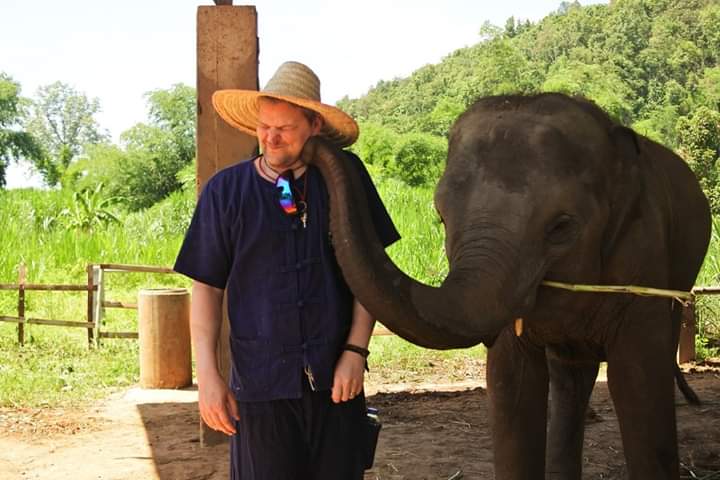
Tip seemed to be the most trained of the group (perhaps because she'd lived there her whole life), and was very good at giving hugs.

She followed each hug with a rather delightful kiss, including causing tickly suction. J's neck is extremely ticklish, but he gave it a try anyway, with satisfyingly hilarious results.

This is my favourite picture from our whole trip! How completely adorable is that? Tip is so photogenic!

After the elephants finished their sugar cane, they went down for a swim in the river, where they ate something that looked to me like water lilies. They also helped us to cool down. We could see their handlers (who live with them at the sanctuary and have strong, lifelong partnerships with them) giving them signals and talking to them, but didn't realize what they were saying until the sheets of water spurted out of their trunks!

Then came my favourite part. We followed the elephants into a squelchy, muddy pond (that reminded me of my Uncle David and Aunt Susan's mud pond, the location of some pretty fantastic childhood memories). It was such a relief to wade into the cold water after ages in the sun, and it was clear that the elephants enjoyed it too. We gave them a mud bath, scrubbing and spreading the cool mud all over their amazing skin.

You'll notice that most of the rest of the group got in the water up to around the knee area - not me! I'm the little one behind the lounging elephant. In their defense, I should report that there was definitely elephant poop floating in the water, in addition to whatever delightfulness lurked in the mud, but even J the germ-a-phobe knows that herbivores' poop is very nonthreatening germ-wise, and plus, we were swimming with elephants! I wasn't going to go half-way on that! Also, it probably helps that I grew up swimming in mud ponds. Thanks, David and Susan.

Then we went into a clean(ish) pool and rinsed all the mud off. I definitely managed to get as muddy as the elephants, which I always consider a win when it comes to mud ponds.

After the clean pond, we changed back into our regular clothes and had a delicious lunch together by the river, then headed back into town. It was actually hard to believe that so many amazing things had happened in just one morning. We were exhausted from the heat (which will be a common trend in my posts) but also I think worn out from so much excitement! J and I took a long nap when we got back to the hotel, and I don't think we were the only ones.

I will now share some other elephant-related photos from our trip, starting with this rather clever towel elephant in our first hotel. Elephants are very important in Thailand, and so they are represented in a lot of art, temples, and other cultural landmarks. (And, apparently, hotel towels.)

I will write a post about our day in Sukhothai Historical Park, but I decided that this elephant pagoda belongs in this post. That's J on his bike, riding by.

It's hard to see the beautiful detail in that first picture, so here is a close-up. I love how they are stepping right out of the bricks!

This white elephant is at Wat Phra That Doi Suthep temple. White elephants are very rare and sacred. Traditionally, when a white elephant was born, it would be considered the property of the king, and transported to the palace. The town where it was born would receive honour and good luck. 

At the same temple, I found this image of Buddha on an elephant. I feel like Buddha could probably manage to make sure not to hurt the elephant while riding him.

We also saw this incredible carving at that temple, which is in Chiang Mai and will get its own post later.

This is a close-up of one tiny part of it, in which sacred elephant are carrying sacred relics up to this very temple (if I'm remembering right).

So there you have it. Elephants are amazing, and Thailand values them very highly and is putting great effort into showing their respect for them. I can't describe how fortunate I feel to have met those incredible four elephants at BMP, and to have shared a morning with them, J, and our wonderful new friends in our group.

Sunday, June 30, 2019

Thailand Part 1: The Art of Cooking Rice

The Art of Cooking Rice

Hello, friends and countrymen and all that jazz.
Emma isn’t feeling super right now, but she does feel that she owes her adoring public some content, so I thought I would take a crack at the old typing machine.
We just got back from Thailand this week, and it was a blast. A very hot, wet… trip.
Poor word choices aside, I did learn a thing or two about making rice that I thought I’d share with you fine people.
I don’t have good pictures of the first bits, but we did get a lesson on the processing, so I have some pictures of that. Bear with me on the stock photos.

Planting

Planting rice isn’t as easy as it sounds, turns out. Actually, you’re going to hear that a lot this post.
So, in order to plant rice, you first need to drain the paddy field of water, and till the land, and plant some seeds. Nowadays they use motorized buffalo (tractors) for this work, but a few people still do it the traditional way.

Credit: Kidcyber

This is what we in the business call a nursery field. Then, the field is re-flooded, and allowed to simmer. You grow up the baby rice until it’s about knee height, then time for replanting in a different flooded field. They move the baby plants by hand to make sure they all get planted with enough room to become big, healthy foody-type plants. Doesn’t look like fun to me, but they probably wouldn’t like sitting all day at my desk either, so who am I to judge?

Credit: Sacred Earth

After letting them get all big and seed-y, it’s time to harvest. They told us you can get about 30 rice seeds from healthy, properly planted rice plant. They look about like this when all done.

Credit: Connexion France’s

Now, we harvest. This can be done with an old-fashioned hand-scythe, or with a modern tractor or combine, as finances allow. Your goal in the end is to get it in bundles of about 25-30 shoots for the drying and further processing.

Getting the tasty bit out

Now we have to get the rice grains out of the plant. This is easier with dry plants than green ones (plus dry rice doesn’t go bad nearly as fast), so we hang the bundles upside-down, or spread them out on a tarp to dry. I didn’t catch how long this takes, but I’m betting it takes about a month from my (very modest) research.

How to get the rice out now? Well, smack it, of course.

We wrap the bundle in a tool that has genuine rope-and-stick-technology, and smack it upside-down on a tarp to get all the yummy carb goodness out. We feed the other bits to the cows and goats and such, which will go with the rice at a later date, but for the sake of time, I’ll leave that bit out here.

So, there’s this pile of seeds wrapped in very tough, fibrous husks on our tarp. Still not very yummy. Time for more smacking!

Credit: Emma’s joy at something she’s allowed to stomp on, for science

We’re going to leap forward from our previous technology to the lever! A big long one, with a bin and hammer at one end, resembling a giant mortar and pestle. Pour the rice in and smash smash smash. This will hopefully get the husk off without smashing all the tasty rice, but I’m betting there’s an art to that, which I haven’t mastered yet. What I ended up with looked more like tapioca, but I’m not in the pro-league just yet.

Now, assuming someone who knows what there doing is involved, we have a pile of mixed rice grain and husks. No, we’re not going to smack them again just yet. Give them some time to recover!

Time for some swishing. I am an expert swisher, but the kind farm person showing us her technique was a bit more efficient than me. The idea is that now the husk is lighter and has more surface area than the grain, so with some good swishing, you can get the husks up and out of the basket-lid-thingy and keep the grains inside. For as-yet unhusked rice, which may be still present in the pile, it’s back to the smashing.

 
Credit: Emma’s impeccable swishing skills and the farming teacher showing us how to not suck and throw half the rice on the ground

Cooking

Well, I think you mostly know about this bit, but you put it in water and simmer for, like 20 minutes. Then add some of that goat from before, a bit of salt, and a lot of red chilli (if you’re Thai), and serve with a fine Chang beer.

This was a lot of work, so have two. You deserve it.

Credit: A very thirsty J and Nok's encouragement of my bad habits (our tour guide)

Credit: A Thai-sized apron on a very-not-Thai-sized person


Sunday, May 12, 2019

Tāwhirimātea Waiata

As I sat down to write this post today (after procrastinating with any number of other oh-so-important jobs), I was unsurprised to discover that I have done nothing blog worthy in ages. My job continues to challenge me mentally, physically, and emotionally every day. When I'm not at work I'm pretty focused on relaxing effectively enough to allow me to recharge and hopefully even be able convince my brain that it can take a break from work while I'm sleeping, rather than construct unreasonably realistic work days in their entirety, such that I wake up feeling like I already worked all day. This means that I've done a lot of reading and a fair bit of Netflixing, as well as enjoying long lunches and Skype dates with friends. All of which is wonderful, but not an interesting blog post.

What I'm learning at work is fascinating and fulfilling, but also largely not appropriate for a blog, due to a mixture of confidentiality (for parents, children, and teachers) and lack of context (for you, my lovely readers). I have decided for the near future to switch to monthly posts instead of biweekly posts, in the hopes that I will have more interesting things to say, and also to give myself the gift of one less thing to accomplish. I may post more than once a month if something fun comes up, but I also might not. We shall see.

Anyway, for today I would like to share something from work that doesn't breach confidentiality and hopefully will be informative even without too much context. It is a waiata (song) that I learned from a colleague at my last job, and that I've now taught my children at my new job. It's one of my favourites, and I was excited to teach it to my new children (and teachers) because they have the knowledge of Māori language to learn and understand it easily and enjoy it even more than my other children did (and let's be clear, they enjoyed it a lot). 

When we learn a new song at Te Puna Reo, we usually make a big sign with the words on it to help everyone learn it, and to support relievers to be able to join in. I decided to have some of the older children who are interested in writing write the words, and it's been such a fun project. Māori is an amazing language to write in, because it's completely phonetic. It wasn't a written language until Europeans came, and then they did their best to write down the sounds they heard, so there aren't any silent letters or letters that can make drastically different sounds in different words. (Side note: There are lots of issues with things having been written down incorrectly, but that's a different story). The point is, when you spell out in Māori, you actually make the sound of each letter, rather than the name of the letter like we do in English. This was my first experience teaching writing in Māori, and I discovered it was wonderful, as we could sound out/spell each word so logically, and the result was correct spelling without me having to say things like, "Yeah, it sounds like it could be a 'k' but in this case it's a 'c'." Anyway, it was lots of fun.

And here is the result:
Translation (in case you couldn't tell by the drawings):
These are the signs (evidence) of Tāwhirimātea (the guardian of weather)
The sun is shining
Rain is dripping
Lightening
The wind is blowing
Cloudy
Snowing/Frosty
These are the signs of Tāwhirimātea

It's a call and response song, so I sing each line, and then the children sing it back. Once they know it really well (and some are already almost there) then the children can take turns leading it, which is a wonderful experience of empowerment.

I added my own drawing of each type of weather. I debated having the children do it, but I wanted each bit to be easily recognizable to anyone, such that new people could more confidently join in with the song. This is often a cognitive conflict in Early Childhood, because we want children to be empowered to do real jobs and to celebrate their work, but we also know that children want beautiful, high-quality things around them, and it can't always be both. So we do what we can to choose the right side of that line for each individual project, and to compromise where we can. I feel, in this case, that the writing strongly celebrates their contribution, so the drawings can be focused on efficacy.

I have learned so many new songs in Māori since I've started, and am thrilled with that! Songs are an incredible way to support language acquisition, and also I just love singing with children!

Sunday, April 28, 2019

NZ's Legal Response to Christchurch Tragedy

I wrote a few weeks ago about the outpouring of love and support that I saw from Kiwis around me after the tragic attack in Christchurch. This has continued, and many people have done amazing work to help in a variety of ways. But it will take a long time to process, let alone recover from such an awful event.

I was, as many people around the world were, shocked to discover that NZ's gun laws did not prevent people from owning the type of weapons that were used in the attack. There is very little gun violence here, and I naively believed that this was partially because there weren't so many or such dangerous guns around. I was stunned to find that there are approximately 1.5 million guns in NZ, and while apparently the majority of these are owned by rural farmers who use them for pest control, it is still a large number. In 2017, there were 30 guns for every 100 people in NZ, which seems so high to me! I learned, to my horror, that in that same year there were 101 guns for every 100 people in the States. For a moment that seemed to mean that I should reframe and think of 30 as not all that many, but I don't want it to be about comparisons, I just don't think we need so many guns! And if we do want to compare, the UK had 4 guns for every 100 people that year, so smaller numbers are achievable.

In the subsequent weeks, I've done a bit of reading about gun laws in NZ, although I have to admit that I haven't done as much as I might have on a different topic, because I find myself getting upset very quickly. To summarize my findings, Kiwis have discussed gun laws over the years when there have been shootings in other countries, including the one in Australia that led the Australian government to tighten its restrictions. NZ, however, has chosen not to do the same. You can read an article about some reasons why, as well as watch a video of one of Prime Minister Jacinda Ardern's statements after the tragedy by clicking here.

As you can see in the video, the government took its role in the tragedy very seriously, and immediately began taking steps to prevent such a thing from happening again. Within a few weeks, major gun reforms passed almost unanimously (119 to 1 in Parliament). The new laws ban semi-automatics and assault rifles, and limit the size of magazines. I don't know anything about guns, but my understanding is that they tried to balance farmers' ability to use guns for pest control and the safety of getting rid of guns that could do large-scale damage. You can read more about the changes to the laws, the current restrictions, and the government buy-back of newly illegal guns by clicking here or here or here.

I realize it says little about my merits as a well-informed citizen, but I don't want to know any more about guns than I already do. I wish that changes had been made before a tragedy forced us all to wake up and take action, but I'm so thankful that the response has combined empathy with legal action, and that the changes have now been made. I have deep respect and admiration for Jacinda Ardern, and am glad that she is able to lead us through this difficult time. I am glad that many of the more dangerous guns in this country will soon be out of circulation, but I am even more glad that Kiwis as a people were able to decide that that was what needed to happen.

In conclusion, I would like to share this letter that was in the newspaper. It is from the President of the International Muslim association and to New Zealand, and it is truly inspiring.

Tuesday, April 16, 2019

Kōrero Māori Mai

As you all probably know, I love languages. I find them fascinating on many levels, and continue to delight in the intricacies of the English language and to find my work to maintain my fluency in French satisfying and enjoyable. My main focus at the moment, however, is Māori. I have been studying it, with varying levels of intensity, for about four and a half years, but have struggled to find opportunities to speak it often enough and with fluent enough speakers to get over the hump and start actually speaking it as a language. I could memorize endless phrases and use them in the right context, but that's not the same thing as using language as a real means to communicate my thoughts and experiences to others. As you will know, that is a large part of why I took this new job, as it provides, at long last, a place where I can speak Māori for a significant percentage of the day, every day. I have only been there for about two months, but I am already astounded and thankful at the progress I've made. I was hoping that much of the knowledge I've tried to cram into my head over the years was rattling around in there somewhere waiting for some organization, and I think that must be the case. Now that my brain is more capable of switching into "Māori mode," I'm able to say and understand lots of things that I wouldn't have been able to a few months ago. Of course, my speech is still riddled with grammatical errors and uncomfortably long pauses where I rifle through my memory for the right word, but the point is I'm speaking the language. Whenever I want to say something I've never said before and can put it all together as I go, I feel amazing! And when the other people understand and act on it as if it wasn't a monumental task (which it was for me) but rather an ordinary conversation, that's when I really feel like I can now say, "I speak Māori." Slowly, with errors, but I'm doing it.

The stronger I feel in my ability to speak Māori, the stronger my desire to advocate for it as a national language. I think this is partially because I now feel that I can back myself better in my statements of advocacy, and partially because I'm experiencing the striking difference between knowing some memorized phrases and speaking a language. And I want the latter for the Māori language, here in its own country.
Anyway, I am very excited about the new shirt I got as part of my desire for advocacy. It says, "Kōrero Māori mai" which means "Speak to me in Māori." I find it a simple and powerful message, communicating that if Māori is one of our national languages, we should hear it spoken all over the place, and should be able to strike up a conversation in Māori in all kinds of contexts. I actually met someone at a party the other day and mentioned that I was learning Māori, and he responded in Māori and then we had a delightful conversation, all in Māori. It was incredible, and I want it to happen more and more! Now, I will still be a bit scared when I wear it that a truly fluent person will expect more of me than I can manage, but I will muddle through and celebrate Māori language to the best of my ability and definitely learn something new in the the process.

One of my friends at the Māori Speakers' group I go to on Saturdays gave me this button from the same company, so I've decided to wear it on my other clothes to keep the message going. I've also ordered a bunch to pass out to anyone who wants one, because I think it's a great initiative, and the proceeds go to a local Māori community, so that's lovely as well.
If you're interested in purchasing clothes or buttons, you can go to the website by clicking here.

I am not taking any formal Māori language classes at the moment, as I thought that speaking it at work every day would be exhausting enough. I think that was the right choice for the initial period, and probably for a little while longer still, but soon I'll want to supplement the immersion experience with structured lessons, especially on grammar, as I definitely need some help with that. I'm writing a lot of my documentation about children's learning in Māori and getting it proofread by my colleagues, so that's helping a lot, and I'm studying with some amazing workbooks at home, but I still need more. I'm not sure exactly where/what that will be, but it's going to be great!