Sunday, June 11, 2017

Zealandia with Mary and Jennifer

I know that I said that I would post about my nature-based programming visit to the South Island, and I will. However, some of the pictures that I'd like to share are still on my work computer, so I've elected to wait until next week to post about that.

I also said that we'd be snowboarding this weekend, and that has not happened either, due to J having a pulled muscle in his back. He is on the mend, and we're crossing our fingers for good weather and healthy backs for next weekend. Anyone who holds sway with healing musculature or Whakapapa weather, please put in a good word.

In the meantime, I'd like to share with you some pictures from a completely amazing day I spent at Zealandia Wildlife Sanctuary with Mary and Jennifer. They are ECE faculty from Kansas State University who had come to NZ to present at the World Forum on Early Childhood Education in Auckland. I have known Mary all my life, in a variety of ways, and then she was my major professor throughout my undergraduate and masters studies at K-State, which was wonderful. Jennifer has joined the faculty since I left, but I met her last time I went to visit, and she and Mary work together, and it was great to get to know her better. They were able to come down to Wellington for three days before the forum in Auckland, and we spent the weekend doing amazing Wellington things, then had a whirlwind day on Monday meeting with Victoria University's ECE faculty and spending time in my centre and the other university centre location. More about the phenomenal brainstorming and sharing we did later.

Anyway, we did many fun things on Saturday, which was a beautifully sunny day. Then on Sunday it was overcast and a bit drizzly. I was disappointed at first, but then the people at Zealandia said it was perfect to come when it was a bit wet and had rained overnight, because that's when most of the birds were out. Great news! And it proved to be completely true, because we saw an amazing profusion of native birds, including many that I'd never seen in all the time I've been in NZ. I got pictures of some of them, but not all, so I've supplemented my own pictures with ones from the internet, so you can see all the birds (and a few other creatures).

I will skip over some things that I wrote about last time we went (about a year ago with Mom, for the night tour), so if you want to look back at that post, click here.

This picture of a Piwakawaka (Fantail) is actually one I took on the South Island, but we saw lots of them in Zealandia, and I'm deeply proud of having gotten this great shot, so I'm still using it. Piwakawaka love to flit around people and fan their beautiful tails at them. It's quite a wonderful display.

The Takahē, which I saw last time we went, are amazing birds with beautiful iridescent feathers.

Unlike last time, she was spreading her tiny, flightless wings as she groomed, It was pretty cool to see. They still definitely look like wings, although it's clear that she wouldn't be able to get off the ground.

All three of us were amazed by the dense tangles of vines throughout the native bush.

Zealandia has a very successful Kākā rehabilitation programme. The Kākā are even spreading out into Wellington, to some people's consternation, as they use their hooked beaks to pry at anything they can get ahold of, and can do damage to trees, houses, cars, etc. I still think it's amazing that these native parrots are making such a comeback, and I love seeing them around.
(Remember how one of them brought a present to me at home? Click here to read that post.)

They have several different types of Kākā feeders, all of which were swarming with Kākā. I particularly like this one, because I liked watching them stretch up to get the food, and also because it made me think of the world's biggest hummingbird feeder.

Also, hilariously, this Tūī was managing to get food out of the Kākā feeder as well. It was trickier, as Tūī are so much smaller, but this one managed it. A lot of people have Tūī feeders by their houses to attract them, and they are basically smaller versions of this.
We heard and saw many, many Tūī throughout our day. Tūī have two voice boxes, and so can make a wide variety of sounds, including guttural clicks and high, lilting notes. Click here to watch a video so you can hear some of its sounds. I couldn't find one where it was more like singing, but that's okay.

A little hard to see, due to effective camouflage, but this is a Kākāriki, which is a type of parakeet. Kākāriki simply means "green" in te reo Māori, and so is not the most creative name, but the bird is beautiful.

I couldn't resist this fern silhouette. I think I have always been a touch obsessed with ferns.

And to go with the view from below, here's a view from above. We climbed up a lookout tower, and although the view in general was lovely, I just couldn't get over the beauty of this fern!

This is the picture I managed to take of a Hihi, which I'm including only because I'm proud to have gotten one at all.

Here is the internet's picture, which is much more informative, not to mention impressive. Hihi (also known as Stitchbirds) are nationally endangered, but conservation efforts are going well.

We also saw Silvereyes (also known as Waxeyes), but they were a zillion times too fast for my photography skills, so we'll thank the internet again. Silvereyes are thought to have been blown over from Australia, which I find almost unfathomable, especially for such a teeny-tiny little bird. Their colours and distinctive white eye markings are beautiful.

This stately Tuatara had found one of the few places where a sunbeam had broken through the clouds, and was clearly very pleased with herself. As I've mentioned before, Tuatara have been largely unchanged since the time of the dinosaurs, which makes them pretty darn impressive.

At the recommendation of a volunteer, we ventured into this old mine. We were given hard hats (thank goodness, as I bumped my head twice) and red night-vision torches (flashlights), and went in to look for cave wētā.
(Note: This is also the last of my own personal pictures. The rest are supplied by the internet to show you things that we saw, but couldn't photograph.)

In the cave, in the red light of our torches, we saw three cave wētā like this one. They have much longer legs and smaller bodies than the other wētā I've seen in real life, which have mostly been tree wētā. They also jump, unlike other types, which apparently gave the family in there before us quite a fright!
As a bonus, we also saw some glow worms on the ceiling!

Zealandia also has Tree Wētā (Pūtangatanga) houses along the path, which you can open up to see if wētā are living in there. I checked lots of empty ones, but we finally found one. These are also the kind I often find in the Botanic Gardens with my children.

We spotted a Korimako (Bellbird) at the Hihi feeders. They're beautifully subtle and sleek.

These next two are confusing. This is a Riroriro (Grey Warbler), and I'm pretty sure we saw one flitting through the trees. However, it might have been...

... a Pōpokotea (Whitehead). I realize that they look quite different in these pictures, but I maintain that what we saw could meet the description of either. As we'd all have been thrilled to see either one, we'll just be happy.

They are also both similar to this lovely little fellow, the Toutouwai (North Island Robin). I have seen enough of these, though, to recognize them. I remember them especially strongly because I was shocked to discover that robins here do not have red breasts, as I am used to. They are also much smaller than my robin friends in Kansas.

Thanks to an observant small child and his thoughtful father, we got to see a Tīeke (Saddleback). They were actually extinct on the mainland for 80 years, but are now thriving. Pretty exciting, and definitely beautiful. Also, usually I'm all for sticking with Māori names, but I may deviate from that track for this one, because it really looks like a saddle! Can't you imagine a tiny gnome riding on it? (I was going to say fairy, but they already have wings, so why would they do that?)

Our original plan was to spend about two hours at Zealandia, and then go into town and take the ferry out to Matiu Island. But not long into our stroll, we made the wise decision to take our time, go slowly, admire everything, and not worry about getting anywhere else. I'm so glad we did, because we were there for a least five hours, and every minute of it was amazing. We were gloriously lucky to go on a day when barely anyone else was there, and all the birds were eager to be seen. It was so peaceful to walk through the stunningly lush bush, pointing out birds to each other, chatting quietly about all kinds of things, and stopping frequently to fully immerse ourselves in the sights and sounds of this amazing place.

I feel like I say this all the time, but if you come visit, I'll want to take you here! The list gets longer all the time, so if you come, make sure you have plenty of time for adventures! If you want to read more about Zealandia, click here for their website. 


Sunday, June 4, 2017

Beauty in Queenstown and Arrowtown

The first week of May, I had the amazing opportunity to travel to the South Island with my teaching team to learn about nature-based programming in early childhood education from some of the best programmes in the country. My head teacher, Kylie, used to work at one of them, and had great connections with the others, as well as inside knowledge of all the places we saw, having lived there for many years. It was fabulous to have such a knowledgeable tour guide. I will write a post about the professional learning we did, but I'm devoting this post to the beauty of the places we visited. Being inspired by the beauty of the natural world is an intrinsic part of nature-based programmes, so being in such stunning places was a meaningful addition to our trip.

We flew from Wellington to Queenstown, and I spent the entire hour-long flight in raptures over the views out the window. I knew that the South Island was very mountainous, but I was amazed to see that almost every bit of it was covered in jagged peaks, some snowy and some not. I've never flown over so many mountains in my life!
Another new life acheivement, while we're at it, was that I went the furthest south I've ever been in my life. We went to Winton, which is near the bottom of the South Island, so that is pretty darn far south. Not a lot past it until you get to Antartica. 

This is Frankton Arm, a small stretch of water that connects to Lake Wakatipu. Frankton is where Kylie used to live, and it is something like a suburb of Queenstown (which is on the shores of Lake Wakatipu).

We stayed at a house in Arrowtown for two nights, and this was the view when we woke up. Queenstown and Arrowtown are surrounded by mountains, and the view in pretty much any direction is amazing, especially in combination with such interesting clouds and sun.

We were lucky to be there in autumn, so we got to see all the beautiful colours. Wellington does get colder in winter, but not enough that many trees take a lot of notice, so we don't get the fiery displays, and I do miss them.

We took a walk by a river, and I noticed that there were lots of stones with a greenish tinge (as well as many other colours). The South Island's Māori name is Te Waipounamu, which means greenstone (jade) waters. It was exciting to imagine that some of those green rocks could turn out to be precious jade.

We walked around Arrowtown for a bit. It has a quaint little downtown, and it was nice to poke around the little specialty shops. Also, I love the variety of colours on the hillside.

My favourite place, unsurprisingly, was The Remarkable Sweet Shop, named after a nearby mountain chain called The Remarkables. They had so many delicious things in there, and you could taste test all the fudge for free! I bought J two extra chocolatey kinds, although I preferred the fruity ones.

We drove up to a high lookout with these amazing views. It was frigidly cold up there in the piercing wind, but totally worth it to see the incredible topography. Queenstown is actually not in this picture but just over to the right. It was in dark shadow, as it apparently is quite a lot of the time. 

We went into Queenstown for a delicious dinner at Madam Woo, one of Kylie's favourite Queenstown restaurants. We walked along the lake for a while before dinner, and as the sun set, the light on the mountains was ethereal. 

When the sun descended a bit further, the light lingered on one single peak, which was glowingly brilliant.

Along with autumn colours, I had almost forgotten the delicate beauty of morning frost. I don't miss true cold at all, but there are things about it that I love, and the way frost forms on leaves is one of them.

This was an area where we spent time with one of the nature-based programmes, and it was such a perfect spot. Even though the day was quite cold, the sun warmed us up, and it was peaceful and serene.

I feel that I could post pictures indefinitely, because everything was so completely gorgeous, but I will stop there. J and I will be snowboarding all next weekend, but I will endeavour to get a post ready before we go. I am a bit daunted by the prospect of trying to fit all the amazingness of the nature-based programmes we saw into a blog post, but I will do my best.

Sunday, May 28, 2017

Te Papa Tongarewa Insect Exhibit

Back in April, J and I went to the Insect Exhibit at Te Papa Tongarewa. I have posted about this museum several times before, as it is the single most amazing museum I've ever been to in my life. This exhibit was no exception. It took you into the world of arthropods (insects and spiders) in a very intense way, because they made them person-sized, so it was like you were in their world.

I have to apologize in advance for the quality of many of the pictures. It was quite dusky in the exhibit, which was great for ambiance, but not impressive for photography.

The exhibit was organized into different pods, each of which celebrated a different insect. This grassy one was about dragonflies in a pond, and you felt like you were tiny and walking amongst tall marsh grasses as you went in.

The dragonfly exhibit had this sign by the entrance, which made me laugh. The strobe light effect inside to demonstrate the amazing speed of dragonfly flight was impressive, but not photographable.


This praying mantis was about 10 feet tall, and you can see why it's a threatening predator! I would run away! It is impressively camouflaged among the orchids, and hard to see unless revealed by this UV light.

In one of the many child-friendly interactive activities, there was a large picture of orchids, and the challenge was to find the praying mantises. It was very difficult to do so...

... until you used the UV flashlights they provided, and then they would seem to jump out at you! I was somewhat confused by the use of UV light, as I couldn't see the connection between UV and praying mantises, but J says it was just an effect to help you see how they can be right in front of you without you seeing them. It was very effective.

This jewel wasp is hard to see, because it blends into the background of this pod, which is inspired by its iridescent colours. But if you look carefully, you can see that it is injecting the cockroach with magic zombie-poison under its chin. Apparently, the jewel wasp turns a cockroach into a zombie, then lays her eggs in it, and it sits peacefully under her control (even though she's long gone) as the egg hatches and the baby jewel wasp eats it alive. Revolting, I know, but also pretty impressive. (Also, it made the "human host" comment on the sign I liked a bit morbid.)

One pod was dedicated to an amazing defense mechanism that Japanese bees have against hornets. According to the sign, "Japanese honeybees "cook" their hornet enemy by engulfing it and rapidly vibrating their wing muscles. They can stand temperatures a few degrees higher than the hornet can." In this exhibit, with bees the size of people and an even bigger hornet, children (and adults) had to warm up glass honeycomb panels by rubbing them until the hive got hot enough to kill the hornet, at which point the lights flashed dramatically and we won. The children loved this, making this one of the most consistently crowded pods.

This enormous spider and web suspended from the ceiling were pretty awesome.

There were also lots of actual insects to admire. This one, whose leafiness seems almost excessive, was my favourite.

This one made me laugh, because surely all that body mass could not be lifted by those little wings! It made me think of Heimlich the caterpillar in A Bug's Life, who turns into a butterfly at the end, but just has these preposterously little wings. 

Can you see the similarity?

Anyway, the exhibit was amazing, and I'm so glad we went. Many of my children from Whare Kea also went over the several months it was there, and they all loved it. I had heard a lot about it from them before I went, but none of them said that it was scary. It was good that I had that in mind when I went through, because otherwise I might have worried that some of the insects would frighten them. But they are often braver than I think they'll be.

I'm so glad that there are exhibits like this to encourage people to see how amazing arthropods are, instead of being afraid of them. Their abilities are much like superpowers, and I just love knowing that incredible things like this are going on in the world every day, all around us. It's quite uplifting, somehow.


Saturday, May 20, 2017

Mount Taranaki Part 2: The Summit

I believe we left off last week when I was at the faux-summit, almost to the top of Mount Taranaki. Today, the story continues.

This is looking back down from that faux-summit. The brownish area between all the green peaks is apparently a swampy area that's quite interesting to hike through. I might have to do that someday.

Just on the other side of my faux-summit is the crater, which is full of ice and snow year-round! I didn't know that it was there, because during summer and autumn the mountain looks snow-free. It was pretty amazing to discover.

There was one more grueling climb before we were all the way at the summit, and Lynette, who had already zoomed up there, encouraged us on our way up.

This is my favourite view, I think. A lovely rock structure (called Inuksuks in Canada, and it's still the word I use), followed by the lush green of Taranaki countryside, and then the cool blue of the ocean. With fluffy clouds for an extra flourish.

I also love this picture, because the peaks of four of my favourite mountains are all together. Left to right, we have Tongariro, Ngauruhoe, Ruapehu, and then, of course, Taranaki front and centre.

Again, love the clouds moving around the peaks and valleys, and it is so special that the ocean is right there!


Kirsten, Lynette, and I at the summit, feeling pretty accomplished.

Even a little bit higher than the large summit area was this big boulder. Kirsten and Lynette decided they were high enough, but I wanted to be at the tippy-tip-top, so here I am!

We had lunch at the summit, which was great. Lynette then warned us that we'd better get going down, because it had taken us over 8 hours to climb up, and if it took us many more to get down, we'd end up on jagged volcanic rocks in the dark. I thought we'd have plenty of time, because down is much easier, but we hadn't brought torches (flashlights), so we got a move on.

Remember how I just said down was easier? Not as true as you'd think. We went down a different route than we'd come up, but it was almost as jagged, and required a lot of careful maneuvering. 

After the jagged rocks came the scoria, which I learned on this trip is small pieces of volcanic rock that function very much like ball bearings when it comes to traction, but hurt more when you fall on them. I basically skied down, while Kirsten elected mostly sliding on her bottom. My way is faster, but more likely to result in falls, while hers is safer and slower.
Also, how awesome is that upright rock on the promontory? And the mist makes it look like a castle at the end of the world.

As the sun started setting (at about hour 11 of 13 total) the views were magnificent. I took a few quick pictures, but we were largely focused on getting off the second set of jagged volcanic rocks that we discovered below the scoria.

Even in our rushed state, all three of us stopped for a moment to marvel at one of the most amazing and beautiful things we'd ever seen. Mount Ruapehu was lit up by the sunset, and the blazing fuchsia was even more stunning in real life. 

We just barely managed to get off the hazardous climbing parts before it was fully dark, which was a relief. We then walked for about an hour and a half through what I'm sure was beautiful forest, but I can't be sure, as it was completely dark. But that was okay. The hike took at total of 13 hours, as I mentioned, so we were content to be fairly quiet and just keep walking.

With the hour drive on either end of the hike, it was a long day to say the least, but I slept very well that night and was only a little bit sore the next day. I woke up feeling rested, but it didn't last very long, and I ended up taking a long nap when I finally made it back to Wellington. The following day I was a bit more sore and did a lot of whining, but overall I felt that my body handled the experience very well. All my insane biking up the ridiculously steep Wellington hills has had a positive effect, I think.

As hard as this climb was, it was also an incredible adventure, and the difficulty made me feel deeply satisfied and quite proud of myself. I'm thinking I might do it again someday.  


Saturday, May 13, 2017

Mount Taranaki Part 1: The Climb

I had to start with this picture, because it is too stunning not to go first. I didn't take it, so don't get excited about my suddenly stupendous photography skills. However, it was taken by a real photographer while I was on the mountain, so I'm pretty much in it. Most beautiful picture that's ever been taken of me, I think.

So, several weeks ago, I climbed Mount Taranaki with my friend Kirsten and her friend Lynette. I've wanted to climb to the summit for years, but haven't managed to make it happen, so when Kirsten and Lynette invited me to come along with the Social Club this summer, I jumped at the opportunity. The summit is 2,518m (8,261ft), which is quite high, especially considering that it's only a little way from the coast, and the base is about at sea level. I had heard that it was a challenging climb, but to be honest, I didn't really know what I was getting into. It turned out to be far more difficult, but also far more amazing, than I'd anticipated.

This was near the beginning of our climb. I love patterns of fog in valleys and between mountains.
(Side note: One of my children was recently asked what mist was, and he replied, "It's like flog, but it's floggier than flog." 4-year-olds are wonderful.)

This is looking up towards the summit from partway up. We looked at various views similar to this one for the eight hours that it took us to get to the top, and let me tell you that the summit was in no hurry to get any closer to us, and left all the work to our poor legs and arms. Yes, the climbing included arms. Details to follow.

Fairly early on, we had this amazing view, overtop of the clouds, of (left to right) Mount Tongariro, Mount Ngauruhoe, and Mount Ruapehu, which are at least 150km (93miles) away. I really feel like it's further than that, but perhaps that's because it takes about 5 hours to drive there on circuitous NZ roads. Anyway, I have hiked and snowboarded on those mountains, and they're stunning, and it was amazing to see them like that.
You can read a post I wrote in August 2014 about a Māori legend about these mountain by clicking here. I feel much more attached to this story now than I did then, because I've now visited every mountain and also read the story about a million times. It's wonderful to have stories about the places you identify with.
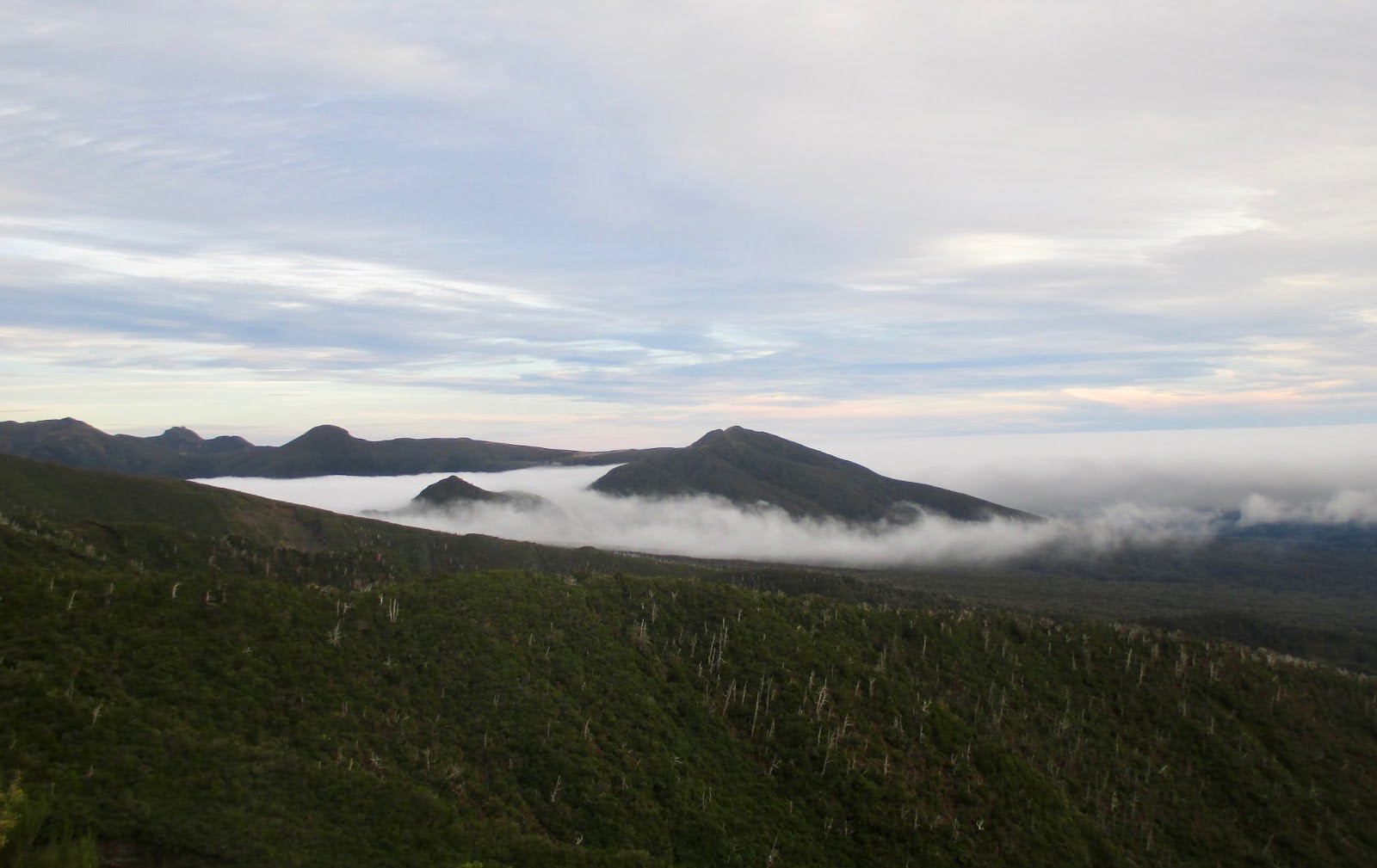
I thought these cliffs we passed were absolutely beautiful.

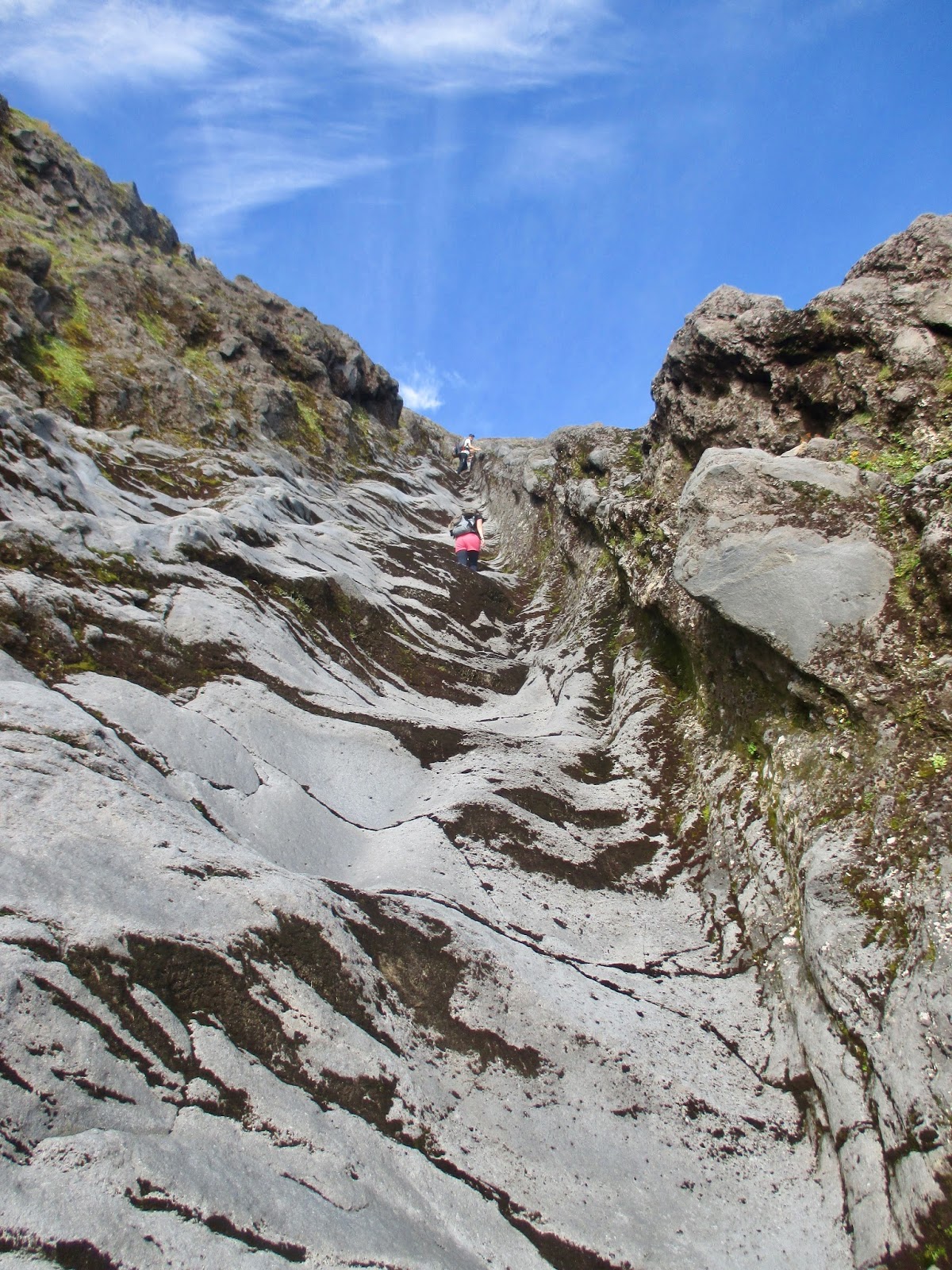
After a relatively easy start on some stairs and paths, we started up towards the Kokowai Lava flow. Turns out, there is no path up to it, and we climbed up through tall grasses, which fortunately had strong enough roots, stems, and leaves to hold us, because it was so steep that we were pulling ourselves up with our hands. It was also challenging because we couldn't see where we were stepping in the dense growth, but it was so exciting and adventurous to be off-track. That's Lynette, who is a mountain-climbing machine!

The real work began once we got to the actual Kokowai Lava flow. It was much less hiking and much more rock climbing than I was anticipating. I've never climbed something that steep without ropes and climbing gear, but we managed! 

There's Lynette again, leading the way, and Kirsten in the blue backpack, both looking carefully for hand and foot holds, which were in short supply in this smooth part of the climb. We're some pretty awesome adventurers, can you tell? We'd didn't let the sheer impossibility of the climb stop us! 

Further up, the smooth lava flow gave way to cracked and jagged volcanic rock, which presented a new host of challenges. Plenty to grab onto and step on, but a high likelihood that whatever you put your weight on will slide, shift, or even crumble away, leaving you loosing your balance on a steep incline. Just part of the adventure! 

I only had one major fall, but each rock I landed on made it's mark. I don't bruise easily, and so was astonished by my decorated arm. The bruises weren't very painful, though, so no complaints.

Getting nearer the top (thank heavens), erosion has done its work, and the rocks have crumbled into even smaller pieces. I don't know anything about volcanos, but the rocks also seemed a lot more porous at the top. Is that erosion as well? Anyway, continued struggles to climb up in increasing altitude and with increasingly exhausted muscles. We took lots of breaks, drank lots of water, kept up a lovely stream of chitchat, and reminded ourselves frequently how impressive we were to be accomplishing this, all of which meant that I was in a pretty darn good mood. I do love a good adventure!

Also, look at the awesome rainbow of colours in the rocks! They are vicious if you fall on them, as their porous nature means they're like incredibly coarse sandpaper. I tested them with my kneecap, just to be sure, and can confirm that they will slice right through skin. But their beauty is worth a scraped knee any day!

This is not the real summit, but I quite like the picture. We got almost to the top, and the Social Club leader-person, who had gone ahead but met us there, said he didn't know how to get to the summit on that side. I thought this meant we wouldn't be able to go all the way to the top, and so took this picture as a consolation prize. Turns out, however, that we could just go around to the other side and up to the summit, which we did. This can be your summit for the moment, though, as I've saved my actual summit pictures for my next post.