Tuesday, June 16, 2015

Marae Visit Part 2: Mihimihi

After the karanga (call), the pōwhiri (welcome ceremony) continues with kōrero (speeches) and often a hongi (sharing of breath by touching noses). After the formal pōwhiri is complete, people often recite their mihimihi. Mihimihi are introductions, which list your important characteristics, including where you are from, who your tūpuna (ancestors) and iwi (tribe) are, your name, etc. Where you are from is described through listing your river, your sea, and your mountain. Please note that this makes more sense in NZ than in Kansas, given that here you can't be more than a few hours from all three of these things. I had to use the Colorado Rockies for my mountain, although that's a stretch. I actually left out the sea entirely, because I figured that it really wasn't reasonable, even if we're willing to stretch it, to say that I come from any sea. (By the way, Kiwis use sea and ocean interchangeably. I suppose that when you live on an island, the difference becomes moot).

Mihimihi are important in te ao Māori (the Māori world) because they help people make connections with each other and to learn a sense of their identity. Much more than in Western culture, your connection to the natural world and your whakapapa (family tree) makes up a large percentage of who you are.

This is my mihimihi, which I have recited several times on marae, as well as at various kindergarten functions. I have translated it into English here, but it is only ever said in Māori. Even many people who don't really speak Māori have done their mihimihi, because it is such a fundamental part of navigating in Māori society.

Tēnā koutou katoa.
Greetings everyone.
Ko Colorado Rockies ngā Maunga tapu.
The Colorado Rockies are my sacred mountains.
Heke iho ki te wai o Big Blue.
I come from the waters of the Big Blue.
Nō Kansas ahau.
I am from Kansas.
Ko George me Peggy Verschelden, Virgil me Marie Denner ōku kaumatua.
George and Peggy Verschelden and Vigril and Marie Denner are my grandparents.
Ko Dean Denner tōku matua.
Dean Denner is my father.
Ko Cia Verschelden tōku whaea.
Cia Verschelden is my mother.
Ko J Mercier tōku hoa rangatira.
J Mercier is my husband.
Ko Emma Mercier tōku ingoa.
My name is Emma Mercier.
Kei te kaiako ahau i te kūra o Puketapu Kindergarten.
I am a teacher at Puketapu Kindergarten.
Nō reira,
Therefore,
Tēnei au e tuku mihi mahana ki a koutou katoa.
This is my warm greeting to all of you.
Tēnā koutou, tēnā koutou, Mauri ora ki a tātou.
Greetings, greetings, well-being to you all.

Now, if I were Māori (or possibly other Kiwi), I would also include my marae (sacred place), my iwi (tribe), and my hapu (sub-tribe) in my mihimihi. I would also include my waka (canoe) if I knew it. Many iwi can trace their whakapapa (family tree) back to the waka on which their tūpuna (ancestors) came to NZ, and that is another important way to get to know someone and to make connections. Since I am American, I have none of these things, so my mihimihi is shorter than most.

The first time I recited this, it seemed plenty long enough, and I was pretty nervous that I would forget all of it, but it was also exciting to be orienting myself through this tikanga (practice). You'll notice that you get almost to the end before you even say your name. I have been told that this is because all those other ways to orient yourself around the land and your whakapapa (family tree) are more important than what you call yourself. Which makes sense, especially in a small place like NZ where you're likely to have connections with a fairly large percentage of the population.

Having now recited this enough times that it flows naturally off the tongue, I really love doing it, and feel empowered by my grounding in NZ each time I do so. It's a great feeling.

Monday, June 8, 2015

Marae Visits Part 1: Karanga

This post probably wins the "most delayed" award, as my first marae visit was... let me try to remember... at least eight months ago. What is strange about this is that it was a very exciting event, so you'd think that I'd post about it right away, but I didn't. I find the task slightly daunting, because each time I go to a marae, I learn so much and am so amazed by what I experience, and I don't know which bits are best to go in a post or how to communicate them meaningfully.

I have temporarily solved that problem by selecting only one of the many things I could write about for this post: the karanga.

You may recall from earlier posts (or you may not, as they were ages ago) that a marae is the sacred space of a particular iwi (tribe), although there are many marae for each iwi. The actual marae is a grassy area outside where formal greetings and discussions take place, but the word is commonly also used to describe the surrounding buildings as well. The marae is a very special place, where specific rules of tapu (sacred) and noa (common/safe) must be followed, and many rituals of tikanga (culture/customs) are practiced.

As a newcomer to NZ and to tikanga Māori, it is special for me to be able to go onto a marae and to learn about how things are done there. The first time I went on a marae, it was with my Te Reo Māori (Language) course at Puketapu School, and we went to Muru Raupatu Marae. The second time was a weekend course on the history of Taranaki, which was at Owae Marae. Both times have been amazing and educational.

When a group goes onto the marae for a pōwhiri (welcoming ceremony), the first part that happens is the karanga (ceremonial call). There is a kaikaranga (person who does the karanga) for the tangata whenua (hosts) and the manuhiri (visitors), and they call back and forth to each other across the marae, while the manuhiri walk across it to be welcomed into the building. The kaikaranga is always a woman. "Karanga follow a format which includes addressing and greeting each other and the people they are representing and paying tribute to the dead, especially those who have died recently. The purpose of the occasion is also addressed. Skilled kaikaranga are able to use eloquent language and metaphor to encapsulate important information about the group and the purpose of the visit" (Te Aka Māori Dictionary online).

This link is to a youtube video of a woman singing a karanga. Usually she would not be by herself, as she would be representing the tangata whenua (hosts), so others would be there with her, and she would be alternating parts with the kaikaranga of the manuhiri. You can tell that she is tangata whenua because the first thing she says is "Haere mai" which means "Welcome," whereas the manuhiri (guests) say, "Karanga mai (ra)" which means "Call to us."
You can hear the strong voice she uses; in a pōwhiri, she would be calling across the marae, which you will recall is a large grassy area. You have to be loud to be heard across it, and it is also a proud part of the ceremony, and your voice needs to be strong to communicate your mana (prestige/spiritual power).

When a group goes onto a marae, at least one person needs to be responsible for singing the karanga. In my group of teachers and community members, no one volunteered, and then the teacher asked me if I would be willing to do it. I felt nervous about doing it, as I am not only not Māori, but not even a Kiwi. They assured me that it would be fine, and that I could do a simple karanga simply stating who we were, without all the fanciness they usually include. This also was fitting for the occasion, as we were not coming for an important meeting or family occasion, but rather to experience the marae and continue our te reo (language) course.

Anyway, I fearfully but excitedly accepted the role of kaikaranga. I was surprised that some of the Māori ladies in the course didn't offer to do it, especially since some of them had previously been to the marae, but I figured that they had their reasons.

Due to a miscommunication between the teacher and myself, I didn't get as much guidance before the event as I thought I would, and so I ended up standing that the front of my group at the entrance to the marae, holding a little piece of paper hidden in my hand to make sure I didn't forget the words, and feeling about as nervous as I ever remember feeling.

I didn't take any pictures that day, so I resorted to finding this one online. We started out right under that archway, and then I sang the karanga as we walked toward the tangata whenua, who were standing into front of the white building.

This is the karanga I sang.

Karanga

(to reply to host karanga)

Karanga mai ra, karanga mai ra, karanga mai ra.       
Call to us, call to us, call to us.
Karanga mai ra ki a matou Te Hua o Puketapu e. 
Call to us, the seeds (people) of Puketapu (School/Kindergarten).
Karanga mai ra, karanga mai ra, karanga mai ra. 
Call to us, call to us, call to us.

(sung after the hosts’ 2nd karanga)

Tenei matou Te Hua o Puketapu e karanga nei. 
This is us, the seeds (people) of Puketapu calling back.
Karanga mai, karanga mai, karanga mai. 
Call us, call us, call us.

As you can tell, it is very simple and straightforward, but it didn't feel that way when I had to sing it out in that high-pitched melody like the woman in the video, and make sure that it was plenty loud enough. I was shaking by the end of it, but everyone said that I didn't look as terrified as I felt, so that's good at least.

I had some interesting conversations as a result of singing this karanga. After the ceremony was over, several pākehā (non-Māori Kiwi) women came up to me and said that they respected that I had done that, because they would always be way too scared to do it. They then continued on to say that they thought it was deeply rude and inconsiderate of the Māori ladies present not to do it, and to thereby force someone like me to take up that responsibility. I said that I didn't mind because it was a good experience for me, which is true, but I wondered about their comments.

Just a few minutes later, one of the Māori ladies there came up to me and told me that I'd done a good job. She then explained that in the tikanga (cultural practice) of her whānau (family), that only the kuia (oldest female) can do the karanga. She said that it would be deeply disrespectful and hurtful to her mother and grandmother for her to do a karanga while they were still alive. She said she felt bad sitting by while I did it, but that it was important to her to respect her family. Of course I assured her that I thought that was wonderful and didn't mind doing the karanga anyway, but I could tell that she felt some tension about it.

The sad thing about all of this is that the pākehā women went home feeling that the Māori women were inconsiderate (when in fact it was quite the opposite) and the Māori women went home feeling that they offended someone either way, when if both side had actually understood the way the other was feeling, everyone would have seen that no one needed to be upset. How many instances of cultures coming together are characterized by that kind of unnecessary negative emotion? It's sad, especially when the two cultures have actually been co-existing and often combining for many years, as is the case here. It often seems that everyone understands each other well here, and then events like this remind us that that is not always true.

Not to worry, though. The fact that a group of white pākehā women (almost exclusively) who teach in NZ took time from their busy lives to take a te reo (language) course and to attend a pōwhiri on a marae means that things are getting better. We are learning, and it seems that the most important thing we all need to learn is that other people's way might be different without being wrong.

I feel privilege to have been able to do a karanga, and am glad that I tried it even though I was scared. It was very inspiring and humbling to be part of the ceremony in that way.


Tuesday, June 2, 2015

Canadian Wedding in NZ

This weekend, our dear, dear friends Matt and Kathy got married. In Canada. We desperately wanted to be there with them, and thanks to the miracle of Skype, we pretty much were! Their Saturday afternoon wedding was early Sunday morning our time, so we rolled out of bed, got all fancied up (from the waist up) and plopped down to Skype into their beautiful wedding.

Here we are, looking suitably wedding-esque, I think. Now due to the glory of video chat, what you can't tell is that I still had on my pyjama bottoms, while J was wearing old jeans, and we were both sporting warm, fuzzy slippers. Yay!

We got to watch the beautiful bride walk down the aisle. What a dress, eh? Amazing! That's her son, Jake, who is also a friend of ours, although I don't remember him being so tall and grown-up!

See that lovely lady on the left holding an iPad? Well, it's hard to tell, but J and I are IN that iPad!! We could see and hear everything, and it was amazing! Kathy even gave us a little wave on her way down the aisle! We were so thrilled!
A huge, heartfelt thanks to Yvonne for being our technical expert and Skyping buddy. What a gift you gave us!

Signing the marriage certificate. What a beautiful couple. 
(If you look back at the picture of J and I at the top, you can see that this is the part where that picture was taken, because this is where they are in the little picture at the bottom.)

The radiant bride. This picture will always make me smile.

Matt and Kathy, we are so happy for you! Thanks for letting us be a part of your special day, and for being such wonderful people in our lives.

Also, I cannot expound on the wonders of Skype enough. I feel so lucky to live in a time when I can choose to move across the world from those I love, and while it is often difficult and occasionally heartbreaking, I do not have to sacrifice relationships the way I once would have. I am thankful for that every day, and most especially on this day.

Monday, May 25, 2015

Meet the Princess of the Bouncy Castle

Last term our kindergarten committee (along with the teachers) planned a "Wheel-a-thon" fundraiser. The children got sponsored by their friends and families to ride their bikes, trikes, or scooters around a track we set up, and then the mayor came and gave prizes and we had a sausage sizzle. It was my first Wheel-a-thon, although they are apparently common fundraisers in NZ. 

It was decided at the planning meeting that we should have a bouncy castle to help keep the children entertained while they weren't biking/scootering. There was an awkward moment when everyone realized that someone would have to stay by the bouncy castle the whole time to keep everyone safe, which is not a very fun job. 

Then in occurred to me... I could be the Princess of the Bouncy Castle! The children would love to have a fancy princess show up to the Wheel-a-thon, and it would add lots more imaginative fun to the bouncy castle set up. After everyone recovered from my unsuspected and rather loud proclamation of this decision, they were all thrilled to have the bouncy caste supervision problem sorted, and excited at how much the children would enjoy it.


That week, I took and edited this picture, then turned it into a poster advertising the Wheel-a-thon. I spent quite a bit of the week being amused watching the children pull their parents over to it, saying, "Emma's a princess!" Many of the parents gave a distracted, "Yes, a princess," before doing a huge double take and exclaiming, "Emma really is the princess!" 

I also edited myself into this picture of a bouncy castle, in case we wanted more realism, but then the bouncy castle we actually rented was different colours, so I didn't use this one. I realized, far too late to do anything about it, that I didn't get any pictures of me with the actual bouncy castle I ruled over. Oh well.

At the last moment, I decided to wear my princess dress to kindergarten during the day of the evening Wheel-a-thon, to get the children (and parents) excited about it, so that more people would come. The children were hilariously in awe of me for a while, many of them coming up, shyly taking my hand, saying softly, "You're a real princess," and then darting off to smile at me from a distance. Of course, many of them got over this quickly, which was good, and we had a lovely day.

We sang one of the songs I've taught them recently, in which the children are my horses (my royal horses in this case). In this picture they're giving me high-fives as we count how many royal horses I have.

By the time the Wheel-a-thon started, it was too hot for the velvet sleeves, so I was a bit less formal for the actual event, which turned out well, as I had to climb around a bit to maintain some semblance of safety in my bouncy domain. Keeping children safe and trying to rotate them through fairly while keeping the numbers inside below the maximum was a task that taxed even my royal capabilities, especially given that there were tiny 1-year-olds in there with hulking 12-year-olds.
Notice, please, that I am holding the hand of one of my kids, and that you can see the gold of her beautiful Princess Belle dress she wore in order to match me. There was also a Queen Elsa in attendance. I regret that I can't post the pictures I took with them, because they are the most precious little royal girls you've ever seen!


Sunday, May 17, 2015

Last Pictures from Susan's Visit

This post has a little of this and a little of that, as it contains the pictures that didn't fit into any of my other "Susan's Trip" posts.

It will also be rather brief on explanations, as I caught my left pointer finger in the gears of a drill at work, so I have to choose between trying to reprogram my brain to type without it, or deal with a stab of pain every time I type 'f', 'r', 't', 'g', 'v', or 'b'. I have chosen the former, leaving my brain rather discombobulated, so I will aim to be succinct.

Susan wasn't sure she'd be able to make it to the top of Paritutu, but she did!

We almost never get pictures with both J and I in them, so that was a special treat for us!

After Hobbiton, we took Susan to the Hamilton Garden, which she loved, as anyone would.

The red leaves in the Italian balcony were even more stunning than the green from last time.

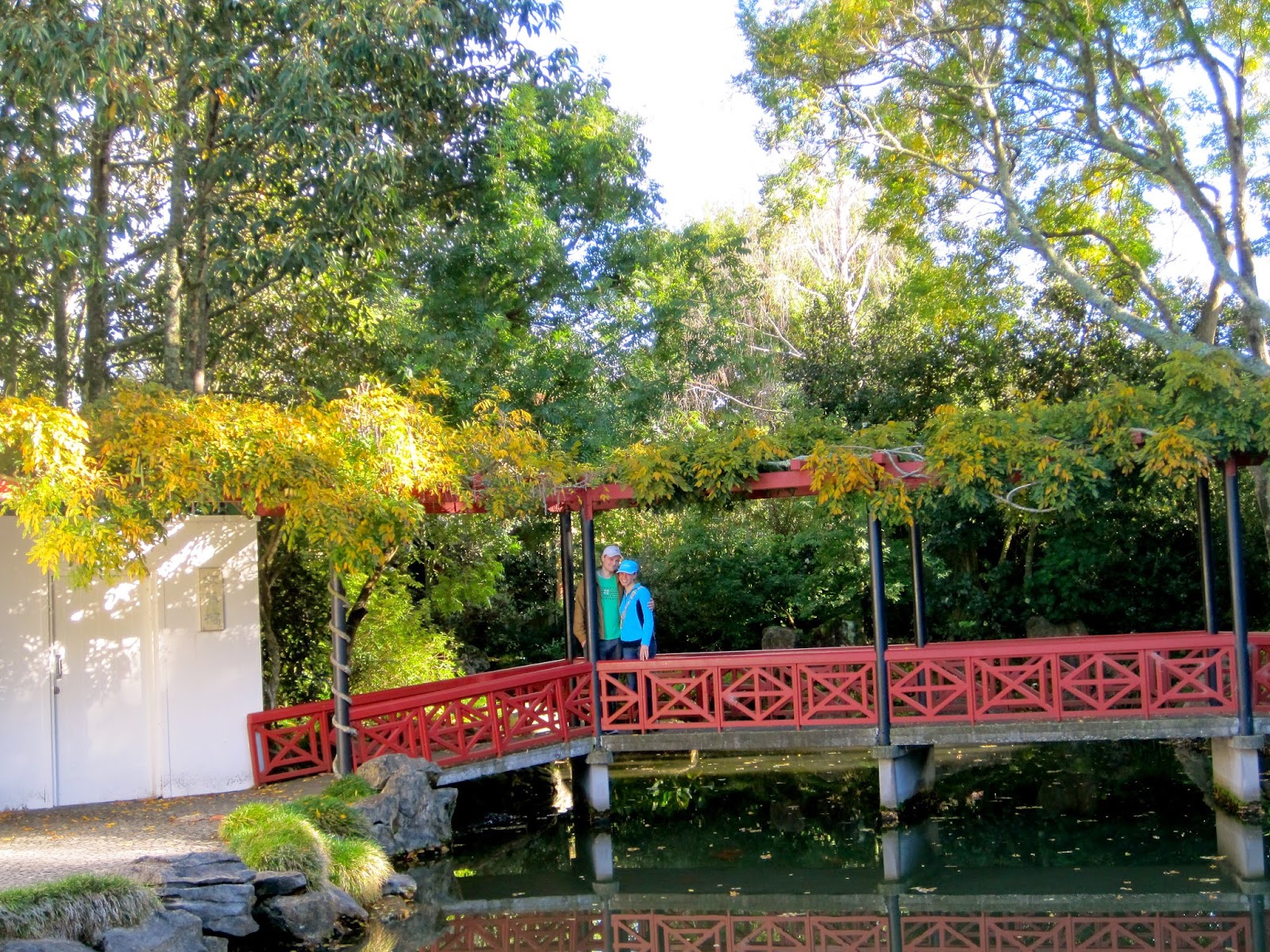
Susan looking beautiful on the bridge, not realizing that the troll has come out from under it and is sneaking up on her!

Since the last time I was in the Hamilton Gardens (with Patty), they have opened a new "House of Tudor" area, including this wonderful Alice in Wonderland/Harry Potter garden.

J was immediately in love with the unicorn, of course.

I liked the dragon, which reminded me of the movie "Flight of Dragons" that I loved as a kid.

Did you know that Kiwifruit grows on vines like grapes? This was a majorly shocking and confusing discovery for me, although I did have to admit, upon reflection, that I'd never had much of a concept of where they would grow. Arguably, they would look just as strange on a bush or a tree.
It was a funny circumstance that we found ripe Kiwifruit on this trip, as Susan had just discovered the previous day that she found them delicious!

Susan fell in love with fantails on her first day in NZ, and decided that the one souvenir she wanted was a coffee/tea mug with one on it. Although we searched and searched, we still hadn't found one when she came to visit my kindergarten. Upon hearing this, my incredibly sweet and thoughtful colleague bought her a cute stuffed animal, complete with fantail sounds. Then when we finally did find this beautiful mug, the fantail set was complete!

Susan and Holly quickly became best friends, and had many lovely cuddles. Susan missed her dogs a lot while she was here, but Holly made sure that she never lacked dog affection.

Well, I'm sure everyone is shocked that I didn't manage to be very brief. Never was my best skill. Off to rest my busted finger now.

Monday, May 11, 2015

Hobbiton Part 2

The Hobbiton saga continues with some more lovely pictures.

This tree above some Hobbit holes was my favourite thing about Hobbiton. Apparently a huge, beautiful tree in an open area by a lake was what they were looking for when they searched for a spot to build Hobbiton, and they found it here. Bilbo Baggins' 111th (eleventy-first) birthday took place on the grass under this huge tree, which is actually a scene from the movie I remember, because it is so fun and pretty.

They had stilts and other Hobbity forms of amusement under the tree so that we could have our own little party. My dad makes stilts like this, so I have had practice, and was able to prance around in them a bit. Susan told me afterwards, with much amusement, that I will be featured in about 10 asian tourists' Hobbiton photos, as they were all taking pictures of me the whole time. Oops.

J tried the stilts as well, but the handles were actually not long enough for him, so it was hard for him to use them properly. But isn't that huge tree in the background fabulous?

Susan and I could totally be Hobbits, don't you think? I'd need a rounder face, but Susan's really got the whole package.

I loved this little water wheel and adorable house on the lake!

At the end of the tour, we got to have a complementary (as in included in the tour price) drink at the Green Dragon pub, which was quite fun. The pub had great ambiance and the drinks were actually delicious.

They had dress-up clothes there, so you could look like a Hobbit. I don't really remember what Hobbits dressed like in the movies, but I had fun dressing up anyway.

It was not a cold day, but I was still delighted with the roaring fire!

And finally... this is my favourite picture of Hobbiton. We have the adorable little Hobbit holes, the pretty little lake, the gorgeous party tree, and the vivid green grass, and it is just beautiful. 

In conclusion, Hobbiton was quite a lovely experience. Not my very favourite NZ attraction so far, but very enjoyable, beautiful, and definitely unique. J and I are pleased that we went with Susan, because her enthusiasm was infectious and helped us get into the Lord of the Rings spirit and enjoy it even more.


Monday, May 4, 2015

Hobbiton Part 1

We learned early on in Susan's visit that a big part of her inspiration for coming to NZ was watching the Lord of the Rings movies and being so impressed with the landscape. She so enjoyed going up into the mountains and seeing Mount Ngauruhoe, which is Mound Doom in the movies, and frequently commented on how the countryside reminded her of the movies. It occurred to me (rather belatedly) that she might like to go see Hobbiton, and when I suggested it, she was delighted. We planned a trip there for her last weekend in NZ, so we headed up to Matamata (north of us in the Waikato region) on Saturday morning.


This is the famous Bag End, where Bilbo and Frodo Baggins (along with many other Bagginses) lived. It is up on top of the hill with awesome views, and is a beautiful hobbit house.
Evidently, in the books, a big fuss was made about the oak tree above Bag End, so the director needed one there. For the Lord of the Rings movies, they moved a huge oak tree there from a neighbouring farm. But then, by the time they did the Hobbit movies, that tree had died, and anyway, they needed a tree that looked like the same tree, but 60 years younger. So they had this tree made exactly to their specifications and placed here. I know that it's fake, but even getting up close to it, it is the most realistic fake thing I've seen in a while.

Susan visiting Bag End. She was so very happy to be there, it was great!

I wasn't allowed in, given that I had no party business to attend to.

They explained when we got there that part of how they make things look bigger or smaller in the movies is by shooting from above or below. For example, Frodo is shot from above, while Gandalf is shot from below, making one seem tiny Hobbit-sized and the other seem tall wizard-sized. 
We tried this technique for this picture, and I think it worked well, although J is much more successfully huge looking! 

They had over 40 Hobbit holes, and many of them were specified to the occupation of the Hobbit who lives there. This one, as you can see, is the beekeeper's house, and while I don't think the hive is functional, there was real honey in the jars and some bees flying around. They try to keep things quite authentic.

J had a go at chopping some tiny wood for Hobbit-sized stoves.

 This was one of the bigger Hobbit holes. 
They had two sizes, so that they could shoot the Hobbits in front of the big ones to make them look small, and then shoot Gandalf in front of the small ones to make him look big. Very clever.

This is one of the smaller Hobbit holes. 
Also, notice the beautiful gardens in the front yard. The gardens throughout Hobbiton are all real and very well maintained.

Recognize this house? This is Samwise Gamgee's house, which delighted J because according to him, "Sam is the only good Hobbit anyway." I don't know about that, but I do remember that Sam comes home to two unbelievably adorable children in this house, so I appreciate it for that reason. And it is beautiful.
Also, thoughtful of J to dress to match his favourite Hobbit's house.

I ended up with too many pictures for one post, so look for Hobbiton Part 2 soon.