Sunday, August 10, 2014

Rotorua Part 5: Glass Blown Sculpture Garden

The last thing we did on our trip was to stop at Lava Glass Studio, which is between Rotorua and Taupo. I had found a deal on Grabone.com (a site that has discount deals for places around NZ) that gave us lunch at the Lava Glass café, a glass blowing demonstration, and entry into the glass blown sculpture garden, all for only $25. Aside from being a fantastic deal, J and I both love glass blowing, so we were really excited to go.

The glass blowing demonstration was amazing and interesting, as such things always are, and the inside of the store had loads of unbelievable examples of glass blowing talent. Since they were for sale, no pictures were allowed inside.

Fortunately, there was no such rule in the glass blown sculpture garden across the way, which was stunning. Here are some of the things we saw.

This rainbow is at the entrance to the garden.

Huge spheres which, although they seem rather simple, are apparently very difficult to make.

Teal mushrooms.

A waterfall of thin glass bowls (for lack of a better word).

One of many sets of lily pads in the little lake.

A bathtub full of glass balls, and more floating in the second tiny lake. Made me think of bubbles, and of how delighted my children would be to play with unbreakable versions of all these things.

Glass mosaic on glass walls.

This was my favourite of all - a whole forest inside a glass ball! Notice the little mushrooms in the middle, and the details of the foliage in the trees and the colours in the flowers. There were even more detailed ones inside for sale.

J smelling the glass flowers. The artists explained that they wanted to give you the impression that you were walking through the forest in the glass ball that I liked so much. I think they succeeded! There were loads more flowers, and even a second field of them in just pastel colours.

These flowers are much bigger, but I still don't quite blend in.

A very pleasant ending to our very pleasant trip.

I can't believe that it has taken me a month to get all of the pictures posted, but I wanted to post them little by little so as to do them proper justice. I have also not been too tempted to rush, since after spending time and money on this trip, we have done a lot of relaxing, which has been wonderful, but has not incited many blog-worthy moments. But not to worry, there are many things rattling around in my little brain that will be happy to be turned into posts before too long.


Saturday, August 2, 2014

Rotorua Part 4: Wai-o-Tapu Geothermal Wonderland

The next day, we went to Wai-o-Tapu (Sacred Water) Geothermal Wonderland, which is a little ways outside Rotorua, and mostly on our way home. Anna and Ollie had recommended it, so we figured we'd better check it out. It was well worth the effort. We had a great morning there, and will definitely recommend it to others.

We turned off the main highway at the Wai-o-Tapu sign, and immediately started seeing steam billowing out from the landscape. The smell, of course, was not enjoyable, but it was pretty neat to be seeing otherwise normal looking bushes and trees, but with this crazy steam everywhere!

We got there just in time for the 10:15 eruption of the Lady Knox Geyser. It doesn't actually erupt exactly every 24 hours, so they trigger it, but they had a cool story to go with it. Apparently, when this area was first discovered by pākehā, it was used as a prison site (way to go, white people). Some prisoners found this hot springs before it was built up into this cone of deposits, and they thought it would be a great place to wash their clothes. To their surprise, the soap they used triggered and eruption, causing hot water and all their clothes to go flying way up into the air! Quite a funny image, if you ask me. Anyway, so they still use soap to put into the geyser to make it erupt each morning.

The eruption was quite cool and very high, but I have to say that it was not the highlight of our trip, and I'm not sure I would get up early to see it next time.

After the geyser, we went into the actual park area, and spend several hours walking around looking at the various embodiments of geothermal activity reaching the surface. These pictures are not in any particular order, nor could I possible manage to post a picture of every cool thing we saw. But hopefully you will enjoy the ones I have chosen.

This is an overlook for what some of the area looked like. Admittedly not the most exciting bits, but it is still nice to get a sense of the layout. A lot of the trails looked like that little one going in between the pools, and you can see the cool colour of the little stream up near the top.

This is me in front of one of the many craters in the area. Many of them have caved in from the heat, or earthquakes, or whatever excitement was going on at the time. They were actually very cool, but hard to get a good picture of, on account of the steam.

This is J crossing the Primrose Terrace. On either side of the small boardwalk we are standing on is hot water/minerals bubbling or oozing out of the ground. Someone described it to me as "death on either side," and I'm not sure that I would go far, but I'd guess you'd get some nasty burns if you managed to fall, and I have to say that I'm glad we didn't find out.

Here is a J-less picture of the Primrose Terrace. Notice the variety of colours!

An interesting note from the guide map: "These sinter terraces are the largest in New Zealand since the partial destruction of the Pink and White Terraces in the eruption of Mt. Tarawera (1886)." 

An interesting note from me: I am glad to have seen the next best thing to the Pink Terraces that I was so disappointed to have missed (by 128 years) in Rotorua. Also, I had to look up the word "sinter" - apparently it means "a hard siliceous or calcareous deposit precipitated from mineral springs." In this case, it is siliceous, and comes from the Champagne Pool. Now we know.

This is the aforementioned Champagne Pool, and one of the most well-known attractions at Wai-o-Tapu. It is 62m (203ft) deep, and the water in it is 74C (165F)! The red/orange deposits at the side (which I hope you can see are very bubbly and awesome looking) are a mixture of minerals including gold, silver, mercury, sulphur, and arsenic, just to name a few.

These raised edges are from those deposits eventually hardening into rock. The guide map says, "The various sinter ledges have been associated with tilting of the pool as consequence of earthquake activity."
I think it looks like the edge of the world.

  
J at the edge of the world. Notice, however that he is in no danger, because there is a very secure fence between him and certain death. And it is conveniently placed right at shin heigh, for maximum impact.
Also, I would like everyone to know that somewhere along the line I have indeed developed some self-restraint, because despite the immense temptation, my voice of reason convinced me not to follow that deliciously enticing path off the edge of the world. (J may have helped a bit with the convincing.)

I have saved my favourites for last - the next three pictures were the three things that I liked the most about Wai-o-Tapu. So here goes:

This is the Devil's Bath, and yes, it really is that colour! Wow! Apparently, it can also look quite yellow some days, depending on the weather, but it was green, green, green on our day!
Note: Lots of things were named Devil's _______. We debated it extensively on our walk, and eventually decided that the most simple explanation was probably the correct one - the Devil is associated with hot things and with the center of the earth, so... these things must be his, and are named accordingly.

This is Lake Ngakoro (Grandfather). I truly love the colour of it, and somehow the fact that it is the size of a normal lake, and yet that amazing colour, makes it all the more exciting. I should have gotten a higher-up picture of it, but this is what we got. 

This is the Oyster Pool, which struck me as quite dainty and tidy in the midst of all this other excitement. This is especially true because not only is the water quite precisely circular, the little bubbles that were coming up surfaced right in the middle like the pearl that it's name suggests.


Saturday, July 26, 2014

Rotorua Part 3: Buried Village

After our delicious lunch by the lake, we headed to the Buried Village, which the owner of our hotel had recommended.

The Buried Village is the site of a Māori village that was buried in boiling mud from a volcanic eruption in 1886. What happened was that the volcano erupted, but a lot of the subterranean heat also went over to a nearby lake and ended up coming out that way - hence, the mud. Anyway, so then it was abandoned, and now it is a tourist attraction.

I realize that this is a somewhat overwhelming map, but I had a lot of things to label on it, so hopefully that's okay. What I find impressive about this is the distance that the boiling mud travelled to get from the lake (orange circle) to the village (yellow circle). That's a long way!
Also, please note that I have oriented the map the way they had it labeled at the museum, which turns out to be a mistake, because North, you will notice, is where West should be. Sorry about that.

This is an artist's depiction of the eruption. Notice the multiple eruption sites, as well as the grey mud starting to come up from the lake in the distance. 
A lot of people died in this event, and I think that this painting captures the ominous, threatening impression of the beginning of it all, leaving you to imagine the destruction and terror once it got to the villages.

This is an artist's depiction of the pink terraces (in the pink circle on the map). These were a huge tourist attraction pre-eruption, and were apparently stunning. People paid a lot of money for transportation to get there, and then for the privilege to draw or paint them. 
If you look on the map at the lake around them, you will see a darker blue area within the larger light blue area. The dark blue is where the lake was before the eruption, and the light is its current area. So the terraces are underwater now. Unfortunately, not only did this mean that we couldn't see them, it also resulted in many hilarious (not) jokes from our tour guide about how we should have planned ahead and brought a submarine.
Note: J's favourite video game (Guild Wars), has recreated these terraces in part of its virtual world, so J gave me a virtual tour after, which slightly mediated my disappointment. Slightly.

This is a depiction of what some of the wreckage looked like after the event.

This is the home of the village blacksmith at the time. Notice the 5-6 feet of mud all around it. I tried to imagine that much boiling mud falling out of the sky, but my imagination fell short.

This is the whare (house) of the village Tohunga (Priest), Tuhoto Ariki. 
He predicted that something awful was going to happen to their village, and he was right. During the eruption, the boiling mud fell on his whare and broke part of the roof, trapping him inside. Unfortunately, due to Māori beliefs at the time, his prediction meant that he was somewhat blamed for the event. The villagers believed that if they touched him, they would bring upon themselves the horror that had been brought upon him, so they left him trapped in his whare for four days! Eventually, the pākehā (non-Māori Kiwis) came and dug him out and took him to the hospital in Rotorua. This was a mixed blessing, however, because the Māori believed that Tohunga (Priests) should not be touched, and the pākehā doctors bathed him as part of their treatment, which was a horrible dishonor for him. In addition, they cut off all of his hair (for sanitation), which was deeply degrading and disgraceful. He had no dangerous wounds or diseases, but died soon after these events, and his Māori community believe that he died of a broken heart and spirit.
I find this story deeply tragic on many levels, and wish that all cultures and people were better at knowing how to respectfully care for one another.

On a much brighter note, we learned that Māori build living whare (houses)! If you cut down a fern tree (not a silver fern tree, because they're sacred) right at the base of the trunk and quickly "replant" it as part of your walls or roof, it will take root and keep growing! Also, NZ fern trees have partially hollow trunks that catch seeds from lots of other plants. As a result, these other plants start to grow (as you see in this picture). This accomplishes two tasks; insulation and camouflage. The little plants grow in between the fern tree trunks, making it wind/cold proof. The houses are built into the environment (in this picture, into the side of a hill, but often into the forest), and when the plants grow all over it, it blends back into the forest, so enemies can't find you! Wow!
Note #1: Most whare are not nearly as short as Tuhoto Ariki's house in the previous picture.
Note #2: Māori have different whare for different purposes. This is a picture of a whare moe (sleeping house), which is a very important one to be camouflaged. There is also a whare kai (eating house), a whare wānanga (school), whare whakairo (meeting house), etc. The whole village would do lots of things together in the different whare, instead of each whanau (family) doing all these things in their individual homes.

As a part of our walk around the Buried Village, we took a little side trek to see this beautiful waterfall. It doesn't look very big in the picture, but it was quite impressive. We also got to see a charming stream that was full to bursting with beautiful rainbow trout, but they were far too fast swimmers for my picture-taking skills. It was very exciting to see them all, though.

After the tour and our independent wanderings, we went to the Green Lake/Lake Rotokakahai (in the green circle on the map). We were told that the level of actual greenness depended greatly on the weather and colour of the sky, and I have to say that we might not have been there on the best day. However, it was still beautiful, and definitely green.

Next, we went just around the corner to the Blue Lake/Lake Tikitapu (in the blue circle on the map). It is definitely blue, but not impressively more so than other lakes, in our opinions.
Also, I just noticed that the clouds apparently ended over the Green Lake (notice the grey sky in the picture) and left clear, blue sky over the Blue Lake! How funny! It was one of those fickle days that couldn't decide how many clouds it wanted, so that is not too surprising, but it sure is a striking difference between those two pictures.

We were quite tired after our horse trek and on-foot explorations, so we headed back to Rotorua, relaxed for a bit, and then went out to dinner before more lazy relaxing. It was a great day.


Monday, July 21, 2014

Rotorua Part 2: Horse Trek

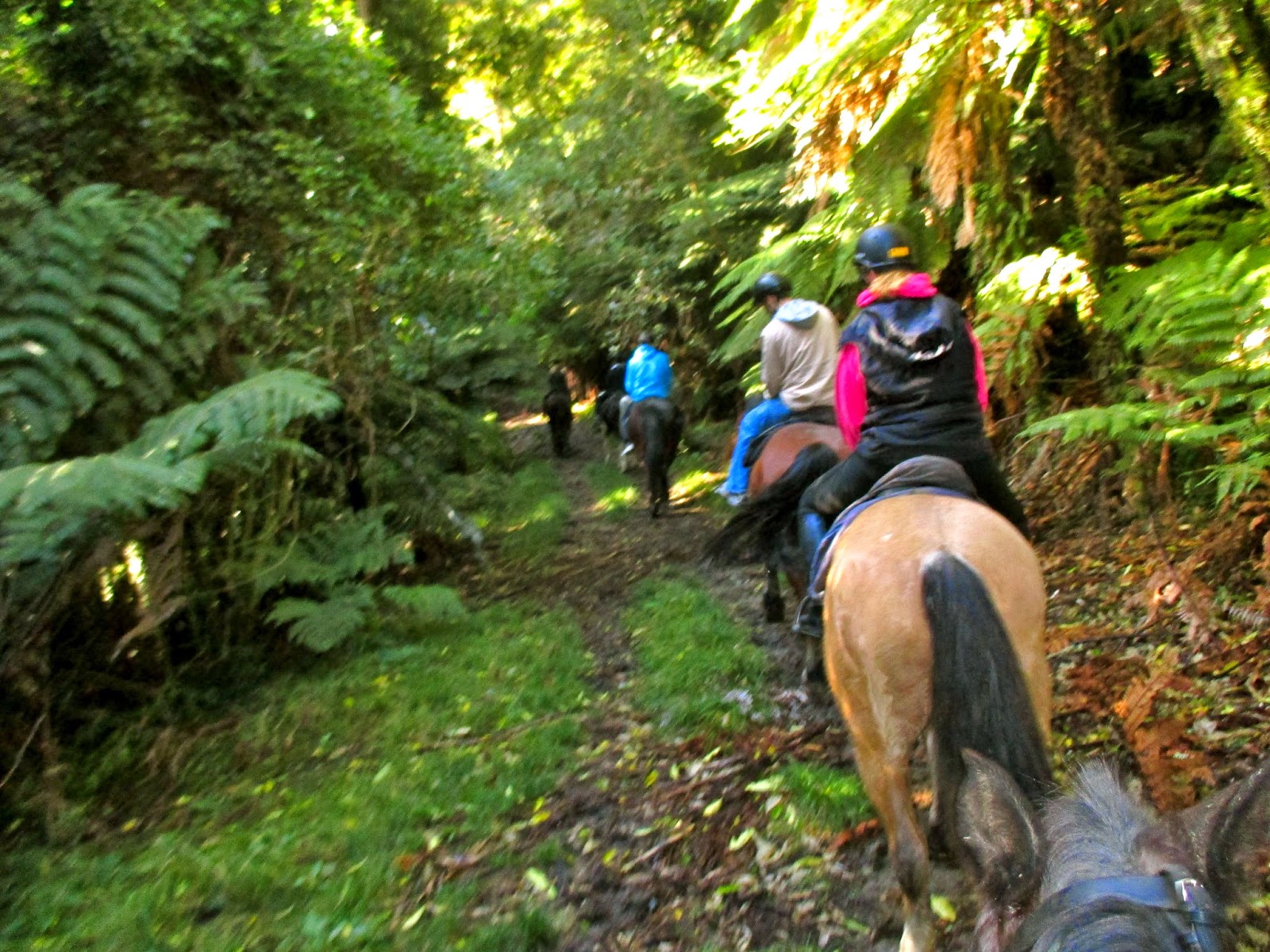
On our second day in Rotorua, we headed out of town to Lake Okareka, about 15 minutes away from our hotel. There we had found a great deal on a two hour horse trek around the lake, through the rainforest, over some hills and pastures, and then back down to the stable by the lake. It was a cold but beautiful day, and we had a truly lovely time. 

Hard to imagine that it's winter.

We ended up with one horse in between J and I, because my horse was being difficult. He was very intent on showing me that he didn't have to do what I wanted him to do, and though I always won, he made it rather difficult to accomplish forward motion at times. 

Equestrian Merciers!

J looking very confident on his horse, who was lovely and just wanted to be nice.

So, as we were riding out of the fields and back towards the lake, I noticed a bunch of fantails (birds) flying along with us. I wondered why that was, and our trail guide said that the horses' feet turned up the soil, making it easier for the birds to find food. I don't really understand this, because they didn't seem to be checking the ground at all, but far be it for me to disagree with her.
Anyway, I wanted to get a picture of a fantail, but knew that I would not be able to focus in on their rapid movements, even if I wasn't on a moving horse, so I didn't even attempt it. Imagine my delight, then, when I got home and looked at this picture and saw a fantail right there in it!

Zoomed in and cropped - TAH DAH! A fantail! Awesome bird, don't you think?

At the end of the trek, after J and I had split off from all the other riders, who were on shorter treks, the trail guide said that since we seemed confident on horses, we could try going faster if we wanted. We agreed, not realizing that the horses took "faster" to mean "bolt." I have never experienced horses going that fast, and 80% of my being was intensely focused on just not falling off. Fortunately, the other 20% of me - admittedly the stupidest 20% - was screaming "YAHOO!!!"and wishing it would never end. When it did end, however, with me mostly still in the saddle, I had possibly the greatest surprise of all which was J, still fully in his saddle, which was rotated 90 degrees to the side of his horse. I turned and saw him at exactly the second when he had to admit that he wasn't going to be able to fix this problem, and was forced to fall, surprisingly gracefully, to the ground. Turns out that his amiable horse had pulled the sneaky horse trick of puffing out his chest when he was being saddled, resulting in it being much too loose and basically letting go when he started running. Thank goodness it didn't fully let go until he slowed back down, or J would have been in trouble. Anyway, excitement all around, and a very adrenaline-filled ending to our horse trek.

After the trek, we went to a little cafe on the beach of the nearby Lake Tarawera and had a lovely lunch and enjoyed the view. Life is good.

Monday, July 14, 2014

Rotorua Part 1: Kuirau Park and Whakarewarewa Forest

Last weekend, J and I went to Rotorua, which is 4 hours north-east of us, meaning that it is most of the way across the North Island. It is also a very geothermically active part of the world, which means all kinds of exciting things to see. Unfortunately, due to the "active" sulfur all around, it also means that it is quite stinky. However, I find that smells are not intolerable for too long, and in this case it was completely worth it.

Although we were very excited to be in Rotorua and see all the attractions, we were also intent on taking things slow and relaxing. So we did (I think), a good job of balancing activities and relaxing in the hotel doing nothing. Which was lovely and well-needed.

On the first day there, we headed down to the local market in Kuirau Park. Coincidentally, this park also has lots of geothermal activity, so we got to have some fun with that. 

The first thing we saw was this bubbling mud, which reminded both J and I of "The Bog of Eternal Stench" from David Bowie's Labyrinth. And yes, it did stink, but it was also very interesting to watch the mud continually move and bubble and explode.

I actually took this picture for my kindergarteners, who are currently enthralled with the adventures of my friend Āwhina the Hippo (puppet), who comes and tells them stories partially in Māori of all the exciting things that she does. Anyway, here she is posing on a pretty bridge in Kuirau Park of which I  forgot to take any non-hippo pictures.

J has always had a love for street food, especially Japanese street food, so we were delighted to find authentic Japanese okonomiyaki in the Rotorua market! The okonomiyaki is the food on the left, and it is a a pancake sort of thing, but with anything delicious you want in it - noodles, cabbage, rice, egg, pork, mochi, squid, etc. We were introduced to them when we were in Osaka, Japan, and haven't had any since, so we were very excited! On the right is a dumpling, which is not particularly unique, but it was delicious!

We did a little exploring in the shops in town centre, which was nice. Our favourite part was this jade store, and especially this beautiful and shockingly huge piece of jade.

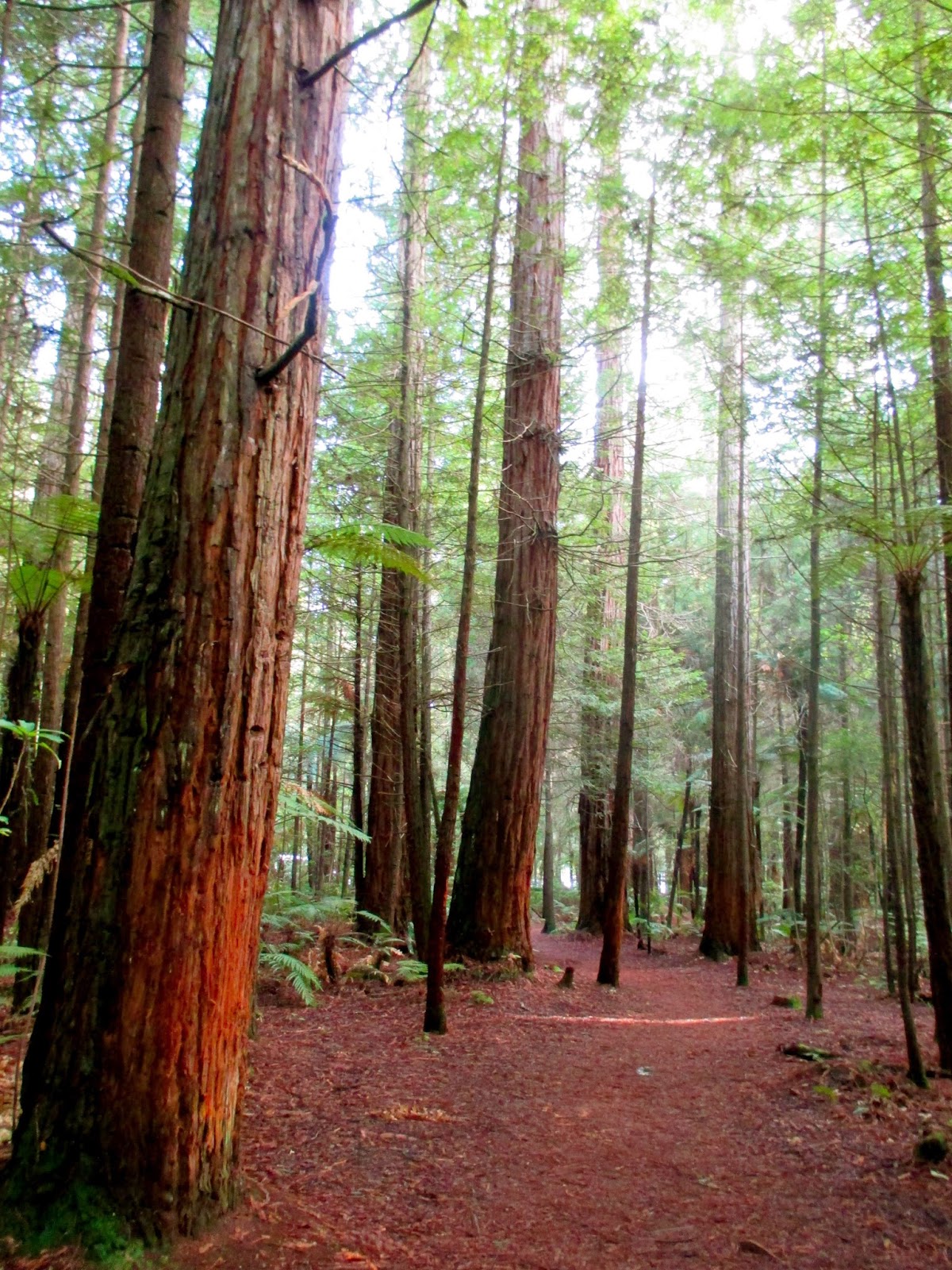
Next, we went walking in the Whakarewarewa Forest, which is a redwood forest. The first trees were planted over 100 years ago by Europeans, and they are amazing! It was such a beautiful place to walk, and the ground was lovely and springy from all the fallen bits.

We love fern trees! We learned some new and fascinating things about them on this trip, which I will share later. In the meantime, it was raining a bit on and off, and I thought that this one would be quite an effective umbrella for J.

As usual, we were thrilled to see the surprise of the silver underside of the ferns.

J exploring the forest.

See what I mean by huge? And there was one big one like this that was "The Mary Sutherland Memorial Redwood." There was a little plaque that told her story - she was the first woman Forestry Graduate in the world, graduating in 1916 from Bangor University in Wales. Later, she came to NZ and worked in the Whakarewarewa Forest.

This eerie blue stream was probably our favourite part of that first day. It was captivating and surreal.

After we both stared for quite a while, J said, "I have an idea!" He borrowed my camera and took this very special picture. Do you notice the trick? It's upside down! The crazy blue of the water plays tricks on my mind, so that even though I've looked at the picture loads of times, I have to keep reminding myself which was is up.

This is zoomed in on the surface of the water, which is so clear that you don't even see it and so you look right through to these ghostly shapes within it. I do not understand the science that makes them white like that, but perhaps it is best that way.

Consider this a continuation of my love affair with ferns of all shapes and sizes. I just can't get enough of them, and I have always particularly loved the rare occasions when the light comes through just perfectly like this, and you get to see their silhouettes.


After a somewhat more intense hike than we had anticipated, we came to this lookout, which I thought would be uninspiring due to the somewhat rainy conditions, but the mist ended up adding to the experience. I could imagine that the blurred distance is the edge of the world.

After that, we chilled out in the cozy hotel for a bit, then went out to a fantastic Japanese restaurant for one of the best dinners we've had in a long time. If you're ever in Rotorua, go to Yamoto Japanese Restaurant. We were walking by it in the afternoon and J said, "Oh look, Japanese! Looks authentic!" A couple came by and was heading into the restaurant, and the lady grinned and said, "It is authentic. And wonderful! You should eat here!" We were delighted both with the review and with the friendliness, and so we went back for our delicious dinner, and it was a great end to a great day.

Friday, July 11, 2014

Terror on the Beach Update: Seals Have Fangs

Remember how I said that Holly the Idiot managed to come away from the seal encounter unscathed? Well, I was wrong. I took her on another walk today, and this time her raucous adventures were of the non-terrifying kind, but they did get her covered in mud, so home we went for a bath. In her post-bath fluffiness, as I was toweling and brushing her dry, I noticed a rather sizable amount of fur missing from her side. My best guess as to how I didn't see it yesterday is that her hair is very silky and smooth, and must have laid over it so that the skin didn't show. Also, please remember that I did not actually finish my post-fight check, because Holly was determined to get right back in there. And then after that, I figured since she seemed fine, what would I be looking for? Well... a bite. That's what.

Hmm, bald spot. Wonder where that could have come from?

Upon closer inspection by J (if one must have an insane dog, one really should be married to a veterinarian), it was discovered that there are, in fact, two puncture wounds from two very big fangs. You can see one at the right end of the bald spot, and the other is in the white area near the middle, but is already swollen to the point of being hard to see. I am a little unclear on how the fangs so efficiently shaved off all of her fur down to the skin without doing more damage to the skin itself, but I am thankful that that is the case.

J is off to get some cephalexin to ward off nasty infections in the wounds, and we'll hope for the best. She is continuing to act completely unhurt, so it's hard to be too worried.

Conclusion Part Three: Do not fight with a seal. They have fangs.